Illumination Under the Ocean: Understanding Bioluminescence and Biofluorescence
By New England Aquarium on Friday, December 19, 2025


Across the ocean, many different animals share a seemingly magical trait: they can light up and glow. In fact, researchers estimate that nearly 75 percent of ocean animals can create their own light!
This happens in two different ways. The first, bioluminescence, is a phenomenon where animals generate their own light from a chemical reaction. The other, biofluorescence, can’t be seen by humans under normal light but is apparent under UV lights or blacklights.
However they do it, the results can be dazzling! Learn more about why illumination is important for ocean animals—and which animals at the Aquarium can light their own way.
Why do animals light up?
Marine animals use bioluminescence in a few ways. For predators like the anglerfish, the light can be used to attract prey. But for others, a flash of light may deter or distract a predator, allowing for a quick getaway. It can also help animals navigate and communicate or even attract a mate.
While biofluorescence is invisible to human eyes under most circumstances, scientists speculate that these animals can detect each other’s glow. Many of the animals that can fluoresce are also masters of camouflage, so fluorescence may enable them to see one another when they’d otherwise be hidden.
How does it work?
In bioluminescent organisms, a molecule called luciferin reacts with an enzyme, luciferase, to create light. For some marine animals, this reaction happens in light-emitting organs or illuminating cells. There are even animals, such as vampire squid, that can release bioluminescent fluid from their bodies.
Biofluorescent animals absorb blue wavelengths of light and emit it at a different frequency, glowing green, red, or orange. While they don’t produce their own light, the bright colors are visible to humans under UV light. Research has shown that many animals rely on special proteins in their body that produce the glow, while others use small molecules to have the same effect.

Bioluminescent Aquarium animals
Here at the Aquarium, there are a couple of bioluminescent animals to discover. The aptly named flashlight fish in our Western Pacific Deep reef exhibit have a pair of light-emitting organs near their eyes, which are filled with a bioluminescent bacterium that produces light.
Pinecone fish, also in the Western Pacific Deep Reef exhibit, produce a similar soft green glow through bioluminescent organs on the side of their lower jaw.

Biofluorescent Aquarium animals
In our 5,000-gallon “Healthy Corals, Healthy Reefs,” you can see corals’ biofluorescent abilities in action. Researchers knew corals could be biofluorescent—but it wasn’t until 2014 that they learned other marine animals shared this ability! During a study of biofluorescent corals, a scientist caught sight of an eel that also glowed beneath the UV lights, leading to the discovery in more species.
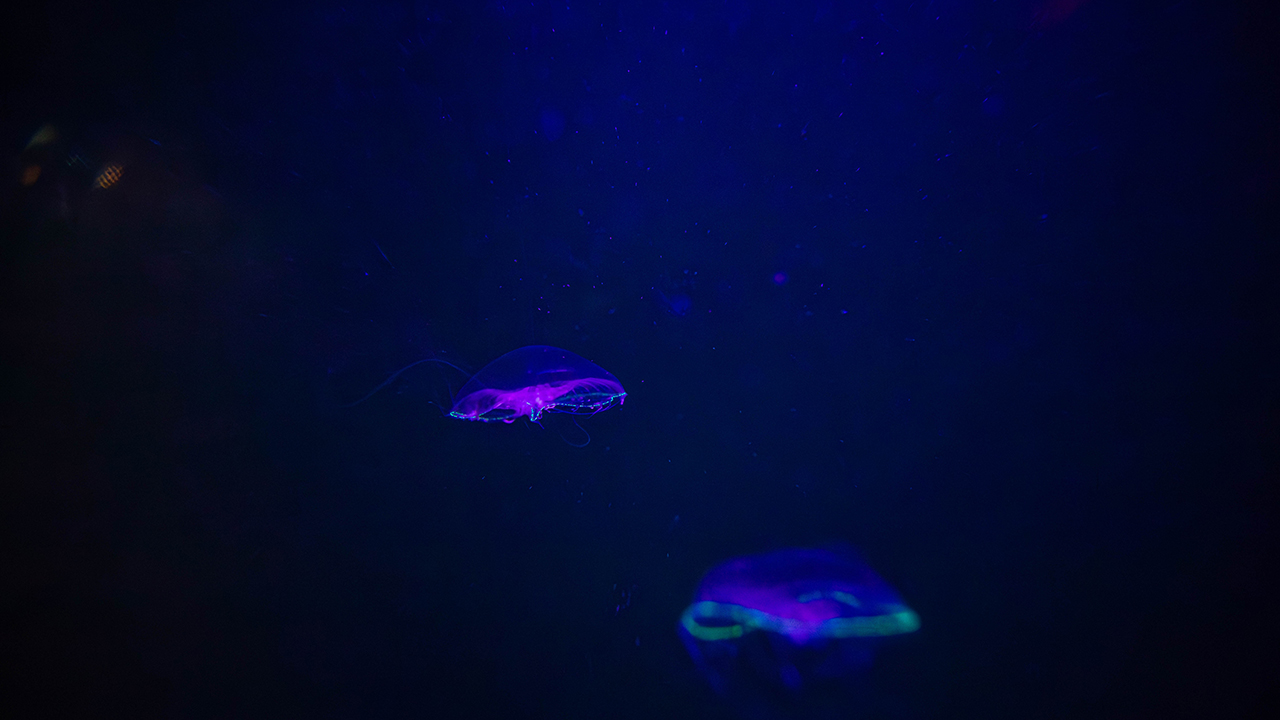
Crystal jellies are another animal whose glow is related to a major scientific breakthrough. The luminescent protein in their bells, called “green fluorescent protein” or GFP, is now used in medical research to study gene and cell expression. A scientist out of the Marine Biological Laboratory in Woods Hole was the first to isolate this GFP in crystal jellies and won the Nobel Prize for his work.
A few of the animals in our Trust Family Foundation Shark and Ray Touch Tank are also biofluorescent! Yellow rays, which have color-changing camouflage to blend in with their environment, can emit a glow under UV light. Chain catsharks also have fluorescent molecules in their skin, allowing them to shine green beneath the waves.

Wait, what about comb jellies?
Comb jellies have a glittering rainbow effect—but it’s neither phenomenon. Their “combs” are formed by rows of cilia, which the jelly uses to swim. When the waving cilia catches light, it often results in a show of rainbows. The more you know! 🌈
Next time you visit the Aquarium, keep an eye out for these illuminating animals whose adaptations help them thrive in the ocean!

Related Stories

Protect the Blue Planet
Your ticket purchase to the Aquarium directly supports our work to create a vital and vibrant ocean for future generations.