Please note: The Atlantic harbor seals will temporarily be off exhibit while we improve their habitat for their comfort and well-being.
PRESS RELEASE
Severely entangled North Atlantic right whale found dead off North Carolina
Health of juvenile whale “Division” had been declining for months, experts say

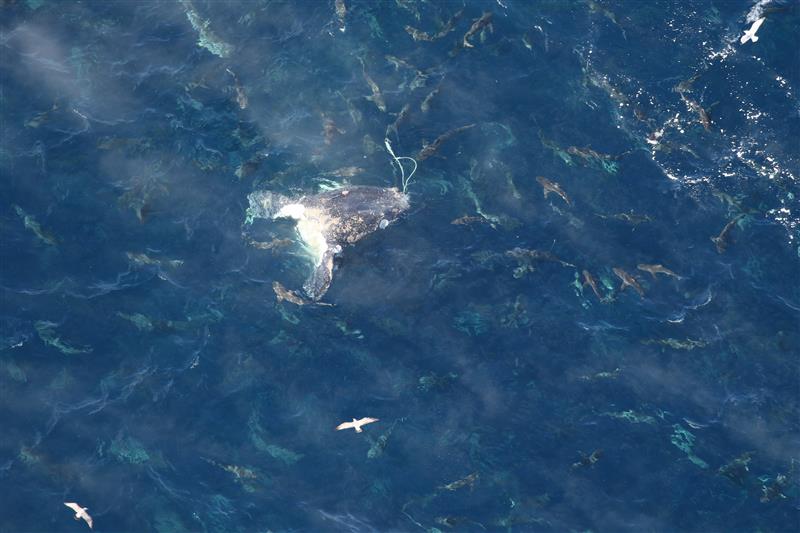
BOSTON, MASS. (Jan. 30, 2026) – A North Atlantic right whale who was in failing health due to a serious fishing gear entanglement has been found dead off the coast of North Carolina, according to the National Ocean and Atmospheric Administration (NOAA).
On Jan. 27, an aerial survey team from Clearwater Marine Aquarium Research Institute spotted a partial whale carcass 25 miles off Avon, N.C. Scientists in the Anderson Cabot Center for Ocean Life at the New England Aquarium reviewed images and confirmed it was “Division” (Catalog #5217), a 4-year-old male right whale. First sighted entangled on Dec. 3, 2025, the whale had fishing line wrapping his head and mouth, cutting into his blowhole and embedded in his upper jaw. After this initial sighting and a partial disentanglement effort by local research teams, scientists in the Aquarium’s Anderson Cabot Center noted multiple indicators that Division had been entangled for some time and that the entanglement had led to a worrisome decline in his overall health. In recent weeks, the whale’s condition worsened. Although Division’s location had been tracked, poor weather and distance from shore prevented trained responders from conducting further disentanglement efforts. He was last sighted alive Jan. 21, 2026, off Cape Hatteras, N.C.
“While this outcome is not a surprise given the severity of the entanglement, it’s still incredibly disheartening to bear witness to the death of a critically endangered right whale,” said Heather Pettis, Senior Scientist in the Aquarium’s Anderson Cabot Center.
Division is the first detected North Atlantic right whale death since May 2024. Given the carcass’ location and dangerous weather conditions, retrieval and necropsy are not possible, NOAA said. Federal authorities are analyzing the fishing gear that was removed from Division in December.
“Division’s entanglement and ultimate death serve as a stark reminder that human activities remain a clear and present threat to this species,” Pettis said.
Named in 2025 for his callosity pattern that looks like the mathematical symbol, Division was regularly sighted in the waters of New England and the Gulf of St. Lawrence. He was the youngest of four siblings, born to mother “Silt” (Catalog #1817) in December 2021. Despite his young age, Division was no stranger to entanglements: Scientists had documented three previous entanglements over the years.
North Atlantic right whales are one of the most endangered large whale species in the world, with an estimated population of about 380 and only 72 reproductive females. Entanglements and vessel strikes remain the leading causes of death and injury for the species. From 1980 to the present, scientists have documented over 1,900 entanglement events involving over 87 percent of the right whale population.
Serious injuries and deaths of right whales caused by entanglements can be substantially reduced through broad-scale adoption of ropeless or “on-demand” gear and weaker ropes. The New England Aquarium continues to collaborate with industry partners, government agencies, and the research community to help advance a collective shift in fishing industry practices to protect these whales.
MEDIA CONTACT: Pam Bechtold Snyder—617-686-5068; psnyder@neaq.org