Online and in person tickets are sold out for 3/14/26. Tickets are still available beginning 3/15/26!
PRESS RELEASE
Entangled North Atlantic right whale severely injured with survival in question, experts say
Juvenile whale “Division” seen with fishing lines wrapped around head and mouth

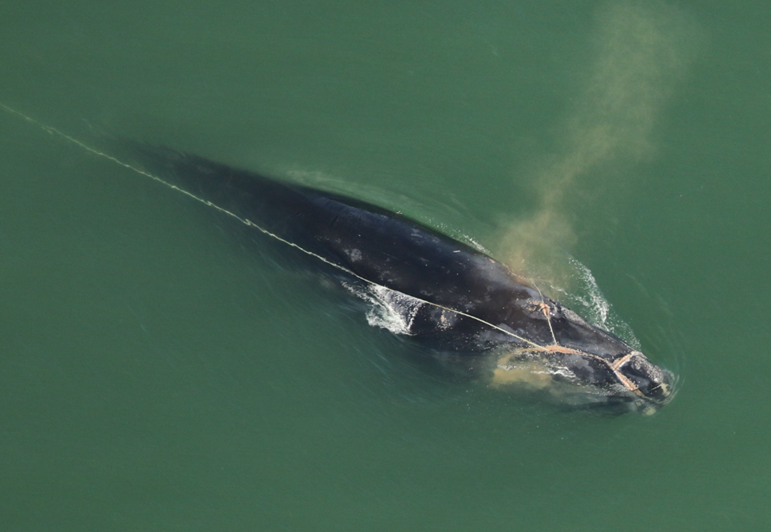
BOSTON, MASS. (Dec. 10, 2025) – A North Atlantic right whale sighted off Georgia with a serious entanglement is facing uncertain survival, experts say, highlighting the ongoing threats facing this critically endangered species.
An aerial survey team from Florida Fish and Wildlife Conservation Commission (FWC) first sighted “Division” (Catalog #5217, named for his callosity pattern that looks like a division sign) entangled off Jekyll Island, Georgia, on Dec. 3. The 3-year-old male had fishing line wrapping his head and mouth cutting into this blowhole and embedded in his upper jaw. NOAA Fisheries biologists have categorized the case as a “serious injury.” Scientists in the Anderson Cabot Center for Ocean Life at the New England Aquarium assessed the impact of the entanglement on the whale’s health, and what they saw was concerning.
“Division’s entanglement is significant and life-threatening,” said Heather Pettis, Senior Scientist in the Aquarium’s Anderson Cabot Center. “There are multiple indicators that Division has been entangled for some time and that the entanglement has led to a worrisome decline in his overall health. Aggregations of whale lice on the head, body, and tail, a pronounced decline in body condition, and a section of remaining rope that is deeply embedded in the top of the whale’s head leave us very concerned for this whale’s welfare and survival.”
Trained responders from the Georgia Department of Natural Resources, in collaboration with FWC and Clearwater Marine Aquarium Research Institute, were able to remove some of the fishing gear from the whale. Further response efforts will depend on the whale’s condition, weather, and resightings, according to NOAA.
Division was born to mother “Silt” (Catalog #1817) in 2022 and has been regularly sighted in the waters of New England and the Gulf of St. Lawrence. He was last seen gear-free in July 2025 in the Gulf of St. Lawrence.
North Atlantic right whales are one of the most endangered large whale species in the world, with an estimated population of about 380 and only 72 reproductive females. This case marks the first right whale entangled with attached gear detected in 2025. Despite a relatively quiet year for right whale injury detections, researchers have noted that the low number may not represent accurate levels of events being experienced by the population, and it will take more time to determine if this reduction is real. The late fall and winter are not uncommon months for new entanglements to be detected for this population.
“Last year, there were four detected entanglement events in December, and so sighting this whale in its current state, while incredibly disheartening, was not a complete surprise,” Pettis said. “We are grateful for the extraordinary efforts that went into trying to free this whale from the gear and hold out hope that Division can overcome the odds stacked against him.”
Entanglements and vessel strikes remain the leading causes of death and injury for North Atlantic right whales. From 1980 to the present, scientists have documented over 1,800 entanglement events involving over 85 percent of the right whale population. Serious injuries and deaths of right whales caused by entanglements are preventable and highlight the importance of broad-scale adoption of ropeless or “on-demand” gear and weaker ropes. Without adequate protection measures implemented throughout the right whale’s range in U.S. and Canadian waters, combined with significant funding support, entanglements and vessel strikes will continue to threaten the survival of the species.
MEDIA CONTACT: Pam Bechtold Snyder—617-686-5068; psnyder@neaq.org