Ask a New England Aquarium Whale Watch Naturalist
A naturalist manager shares how New England Aquarium whale watch partner Boston Harbor City Cruises finds whales, gets to know them by name, and what to expect on your first trip.
By New England Aquarium on Tuesday, July 14, 2026

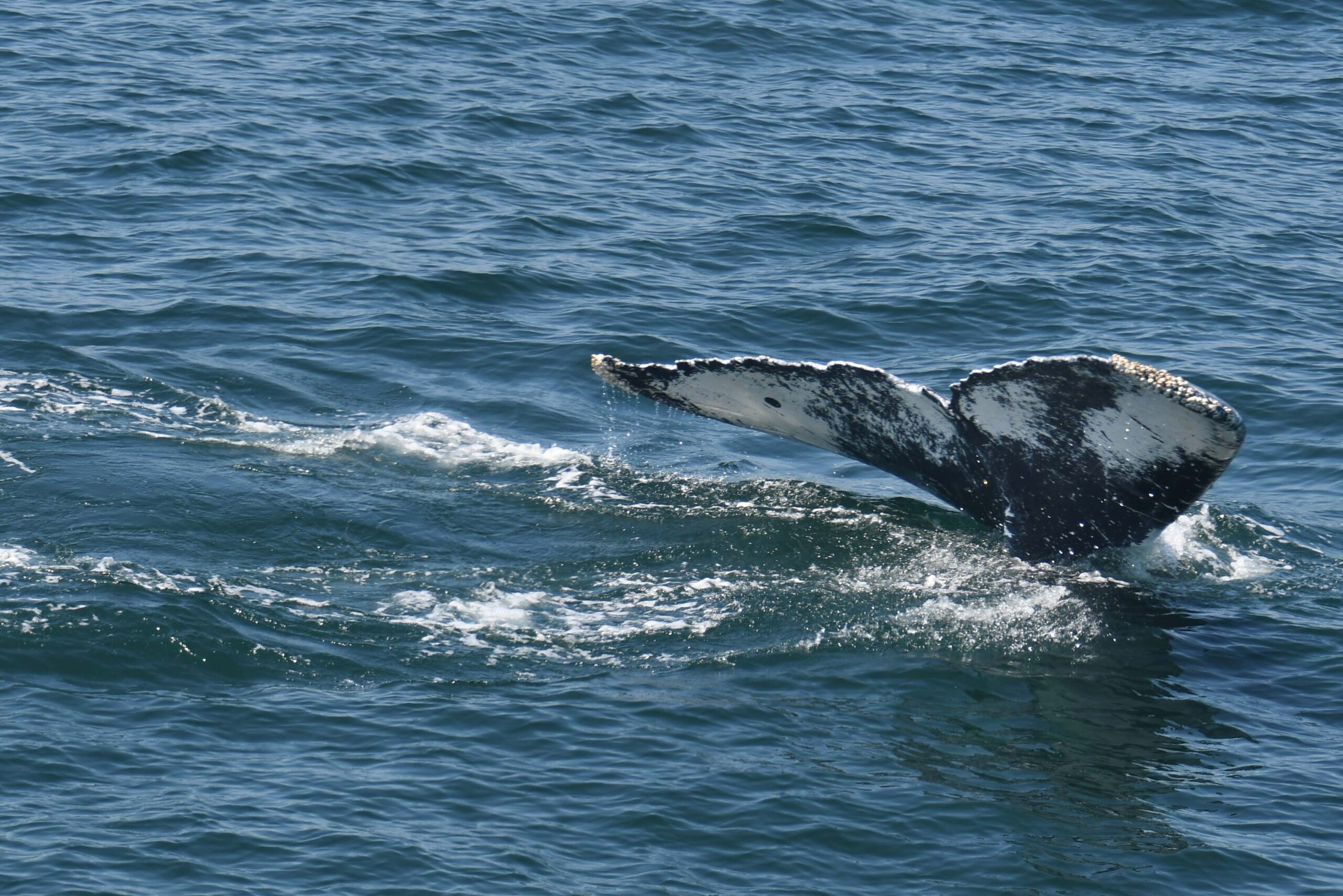
You can see plenty of magnificent marine animals at the New England Aquarium: sea lions, seals, sea turtles, a variety of sharks and rays, an octopus, and so much more. But just steps from the Aquarium doors, from mid-May through November, the Aquarium and Boston Harbor City Cruises offer a window into the world of some of the ocean’s largest and most fascinating animals: whales.
We caught up with Linnea Mayfield Kaplan, naturalist manager at Boston Harbor City Cruises, to get the inside scoop on what really happens out on the water.
What will I see on a whale watch?
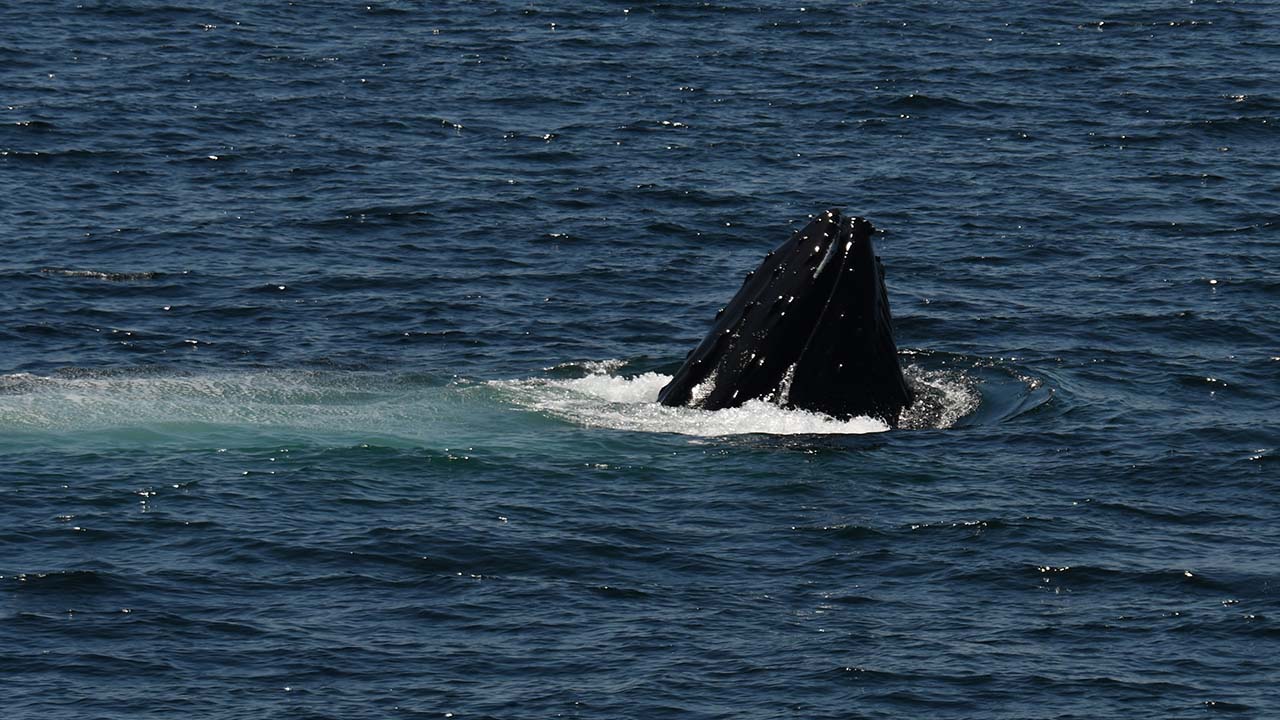
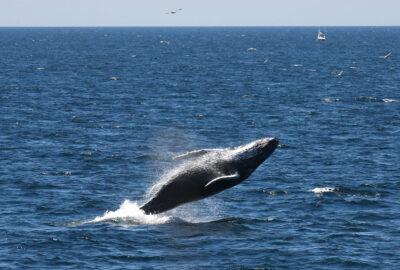
Humpback whales are the most common whale to see, since they spend a lot of time floating right at the surface. Minke whales, a smaller baleen whale, are often spotted. And fin whales, the second-largest animal on Earth, after only the blue whale, cruise these waters as well.
“They can get up to 75 to 85 feet long, but they have this torpedo-shaped body, and they’re very fast, so they can be a little elusive,” Linnea said of the fin whales. You might also catch toothed whales like Atlantic white-sided dolphins, common dolphins, and harbor porpoises, and, occasionally, a surprise baleen whale guest like a sei whale.
These animals all converge near Stellwagen Bank National Marine Sanctuary because it’s a uniquely rich and dynamic feeding ground. The sanctuary sits within the Gulf of Maine, a basin-shaped ecosystem where cold, nutrient-dense water gets funneled up from the sea floor toward the sunlit surface. That sparks an explosion of phytoplankton each spring, which kicks off a vibrant food web all the way up to whales.
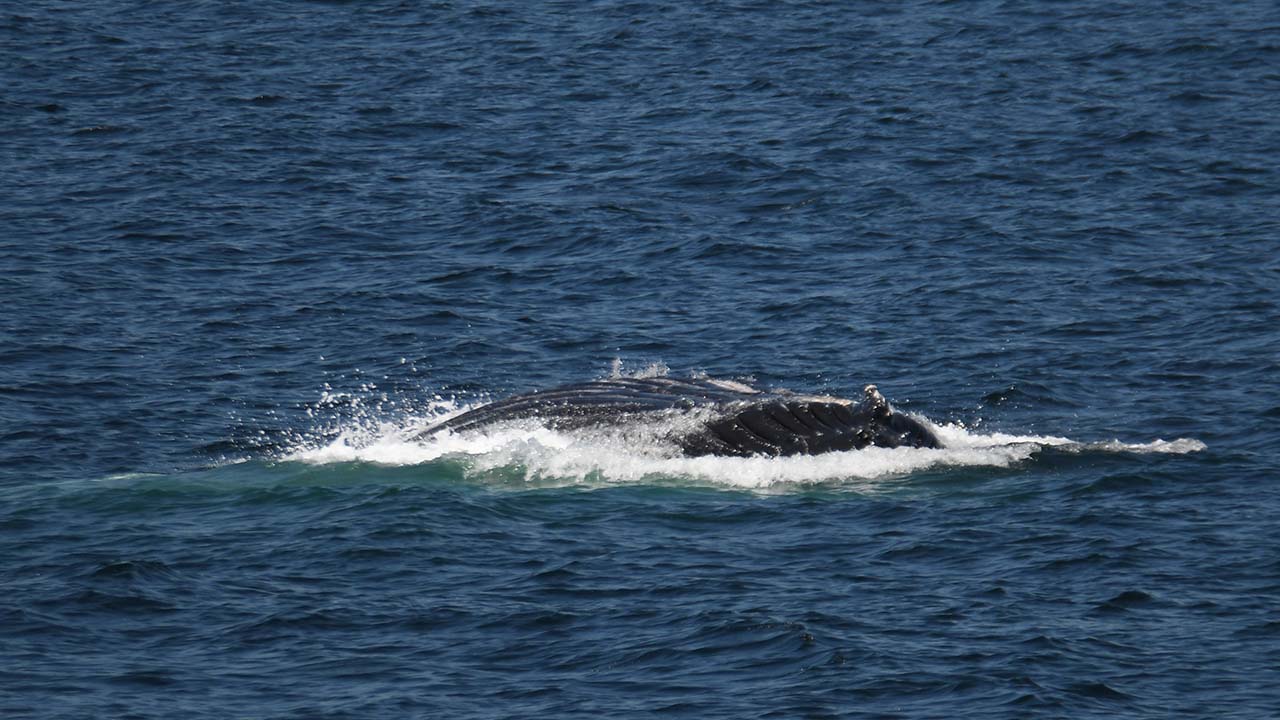
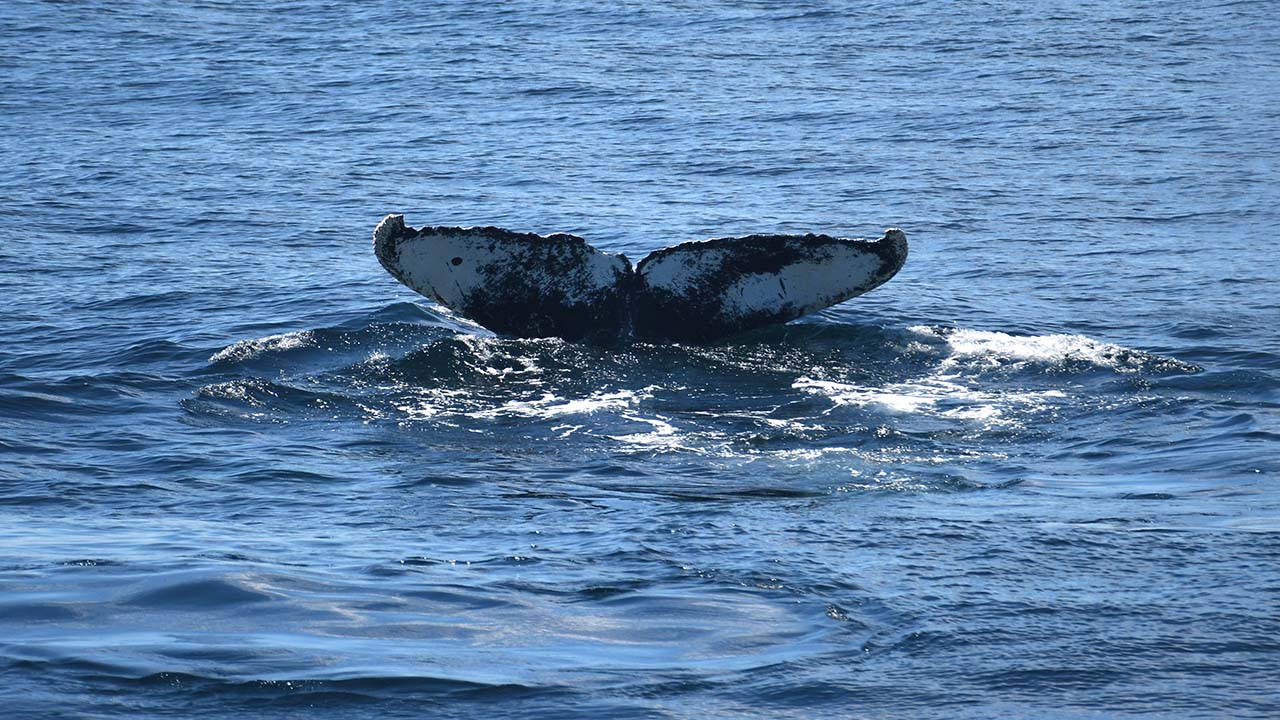
Whale watchers most often glimpse whales’ feeding, traveling, or resting behaviors. Everyone loves a fluking dive, that classic lift of the tail before a whale slips below the surface. Humpbacks also “log,” floating motionless right below the surface to sleep and sometimes use bubbles to corral fish.
“This year, we’re having a little bit of what feels like a baby boom, so we have a lot of baby humpbacks,” Linnea noted. “We’ve been watching some really fun behaviors from babies that read as very playful and curious — some fun rolling, attempts at fluking dives but they’re not quite strong enough to do them yet and it’s really cute.”
How do they find the whales?
Many guests assume the team aboard Boston Harbor City Cruises uses GPS tracking or radar to locate the whales. The truth is much cooler. There is no technology involved at all—just good old-fashioned human senses and knowledge.
Naturalists find whales using what they call the four Bs: body parts like dorsal fins and tails breaking the surface; birds, since sea birds go after the leftovers from feeding whales; boats, because other whale-watching vessels sitting in one spot are a good clue; and a whale’s blow, the exhalation of whales that appears as a column of mist rising from the water. They can spot a large whale’s blow from several miles away on a clear day—and on foggy days, they can hear it and even smell it!
“I wouldn’t describe it as a really good smell, it’s quite stinky. But what’s interesting is that every species has a slightly different scent,” Linnea said. “Minke whales actually don’t generate a visible blow, but boy are they pungent.” The team affectionately calls them “stinky minkes.” And yes, if the wind is right, passengers might be able to smell it too.
Do whales have unique personalities?
Absolutely—and the naturalists get to know those they see the most as individuals. Boston Harbor City Cruises works in partnership with the Center for Coastal Studies, which has curated a humpback whale catalog for about 50 years. The easiest way to tell these whales apart is by the underside of their tails, which carry a unique pigmentation pattern as distinctive as a fingerprint but much larger at up to 15-feet wide.
The humpback whale catalog began with a single whale named Salt, first identified in 1976 and spotted every year since, named for the salt-like markings along her dorsal fin. Today the naturalists have plenty of “frequent flyers” they recognize on sight. There’s Crinkle, seen on nearly every trip of the season so far; Pele and Jabiru, two deeply social whales who pair up year after year; Diablo, who flips onto her back to scoop up fish in a unique feeding style; and Dome, whose blow makes a distinctly foghorn-like sound.
What’s your favorite thing you’ve ever seen on a whale watch?
One sighting Linnea will never forget was of a humpback named Tornado and her calf. Humpbacks use a technique called kick feeding, slapping their tails on the surface to stun fish, and Tornado has a signature sequence—a small kick, a medium kick, then a big one. On this day, she was passing that behavior on to the next generation. “I got to watch her do it and then her baby mimic it in miniature right after, it was the cutest thing,” Linnea said.
Then there was the Fourth of July in 2024, when Linnea and crew saw a blue whale near the Massachusetts-New Hampshire border. Linnea called this once-in-a-decade sighting of the world’s largest animal “humbling.”
What should I know before I board?
Every trip doubles as a research mission. Naturalists log species, behaviors, and weather on each outing for the Center for Coastal Studies. “Anyone who comes on a whale watch is a citizen scientist,” Linnea said. “If it weren’t for our passengers, we wouldn’t be able to collect all this information.”
A few practical tips: bring polarized sunglasses, hydrate, pack layers (it can be significantly cooler offshore), and don’t forget sunscreen. Most of all, come with an open mind. “I always tell people, don’t expect anything,” Linnea said. “This is going to be a unique snapshot moment in time. It will never be repeated again, and embrace that, because it’s really exciting.”
Ready to set sail and learn more about marine life? Save 10% off Aquarium tickets when you buy tickets to a Whale Watch Cruise!

Related Stories

Every Visit Makes a Difference
Your ticket purchase to the Aquarium directly supports our work to create a vital and vibrant ocean for future generations.