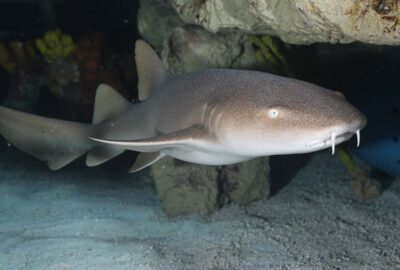
Assessing the metabolic and physiological costs of oviparity in the epaulette shark (Hemiscyllium ocellatum)
By Carolyn R. Wheeler, Cynthia A. Awruch, John W. Mandelman, Jodie L. Rummer
Originally published in Biology Open in November 2025

Abstract
Reproduction in chondrichthyan fishes (sharks, rays, skates, and chimaeras) is generally assumed to be a long-term, energetically costly process, given their slow generation times. However, metabolic costs of reproduction remain poorly understood due to a lack of direct, non-lethal measurements. To address this, we investigated metabolic and physiological changes during oviparous reproduction in five female epaulette sharks (Hemiscyllium ocellatum). We tracked oxygen uptake rates – a proxy for metabolic rate – across a 3-week cycle, capturing data before, during, and after egg case encapsulation and oviposition. We also measured reproductive hormones (testosterone, 17β-estradiol, progesterone) and hematological parameters (hematocrit, hemoglobin concentration). Results revealed a positive but non-significant relationship between metabolic rate and body mass, and contrary to expectations, metabolic rate did not significantly change throughout the 19-day cycle. Hormone levels remained stable, except for a transient testosterone peak early in the cycle, and hematological parameters showed no significant variation. These findings tentatively suggest epaulette sharks maintain reproductive effort without marked increases in metabolic or physiological costs. Continued research under seasonal environmental variation could clarify reproductive energetics in chondrichthyans further. This study provides the first direct measurement of metabolic effects of oviparous reproduction in chondrichthyans, challenging assumptions about energetic demands in this taxon.
Full Text
- Read at Biology Open
Affiliated Authors

Related Stories
Research That Drives Action
Through pioneering conservation research and strategic partnerships, our team of 40 scientists at the Anderson Cabot Center for Ocean Life works to combat the unprecedented impacts on the ocean from climate change and other human activities.
