All About Mangroves: The Tree That Lives in the Sea
You might come to the New England Aquarium for the seals or sharks, but you’ll want to stay for the trees.
By New England Aquarium on Wednesday, July 29, 2026

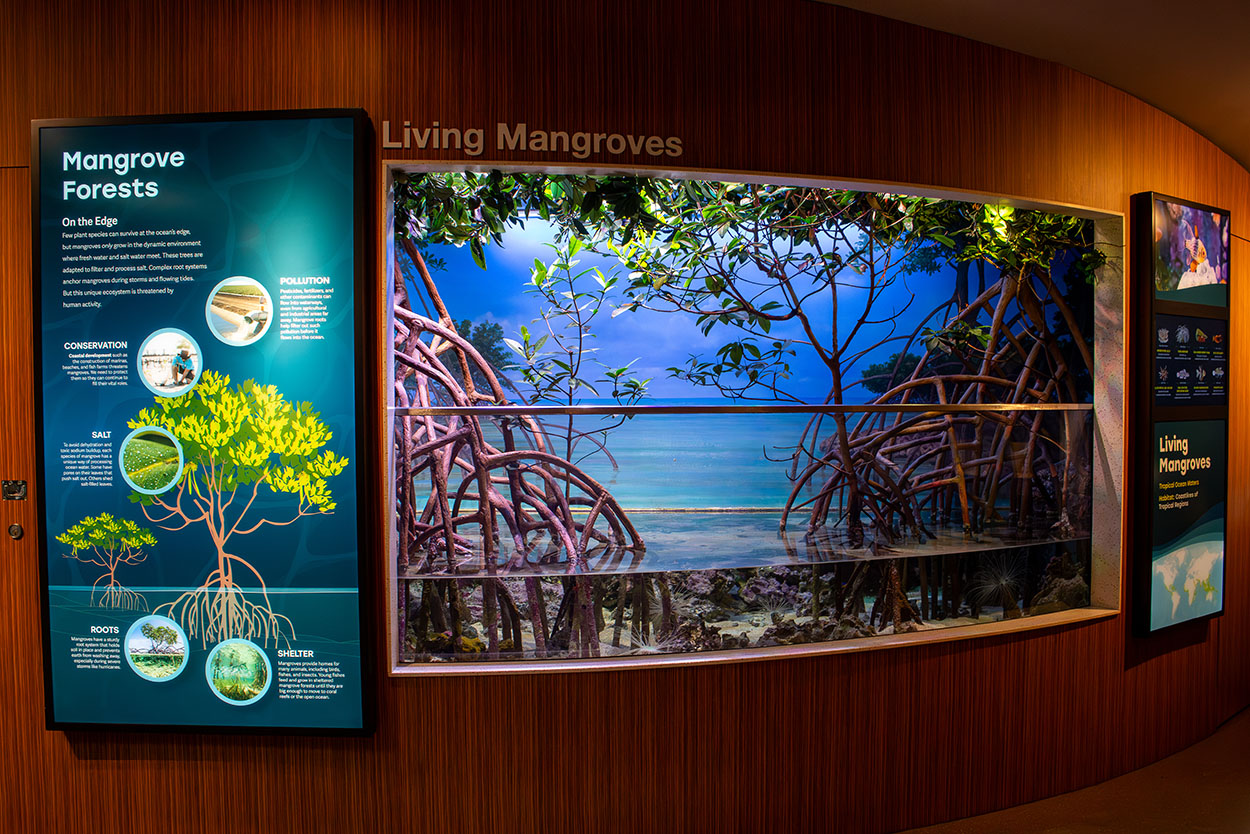
The New England Aquarium offers a unique window into marine life—and that includes not just animals, but the trees that build coastal habitats like mangrove forests.
Mangrove trees are every bit as important to their tropical ecosystems as the animals that live among them—and just as cool. These trees can thrive with their roots submerged in saltwater, a feat almost no other tree can survive. They also protect the animals too small to fend for themselves in the open ocean and coastal communities that live nearby.
Trees in the sea
Mangroves have evolved to handle almost any salinity. In saltwater, they run an internal filtration system, using magnesium drawn from the water to force sodium out of their cells. Some species “sweat” the excess salt out across all their leaves, while others load it into a single “sacrificial leaf” that dies and drops off.
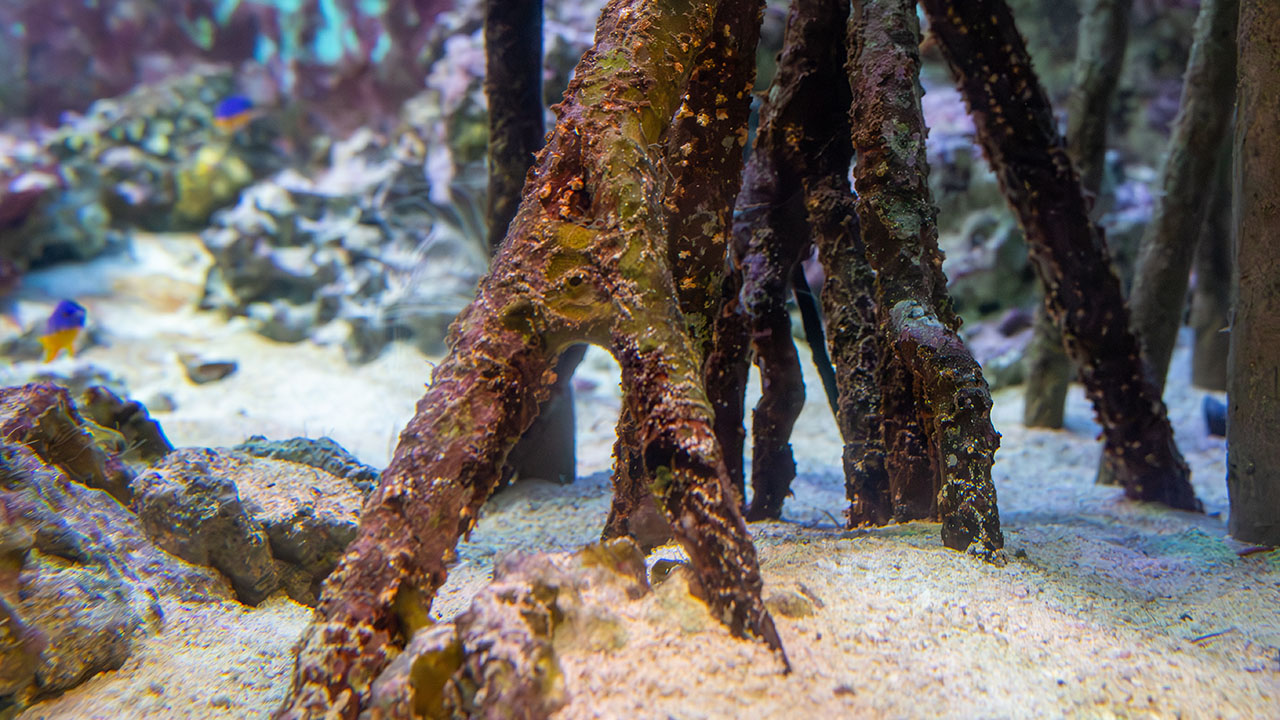
There are about 80 species of mangrove tree around the world, living primarily along warm, tropical coastlines. Mangroves don’t look much like a typical tree: instead of one tall trunk, they sprawl, with their roots splitting off in every direction. Perhaps the most recognizable is the red mangrove, with its prop roots arching down into the water. You can see red mangroves for yourself growing in the middle of our Live Mangrove Exhibit. Visitors sometimes ask if they’re fake because of their thick, bright green leaves, but they’re the real deal!
The ocean’s nursery
Mangroves are one of the ocean’s most important nurseries. Their dense tangle of roots creates a calm, sheltered space, and for countless young animals, it’s the safest place in the sea. Small fish live and hide among the roots, and many larger animals come here specifically to lay eggs or give birth, leaving their young somewhere predators can’t reach.
Sharks and rays use mangroves this way, along with snappers, which gather here in large schools. Some shark species lay eggs fitted with long tendrils that wrap around the mangrove roots to anchor them in place. The parents move on, but when the baby sharks hatch, they’re already home, tucked safely into the mangrove. Young animals grow up in this protected habitat and venture out into the open water once they’re big enough to hold their own.
Mangroves have a unique way of reproducing themselves. Seedlings called propagules grow while still attached to the parent tree, dangling from its branches until they eventually drop into the water. From there, they drift until they settle into the seafloor, take root, and grow into new trees.
Coastal guardians
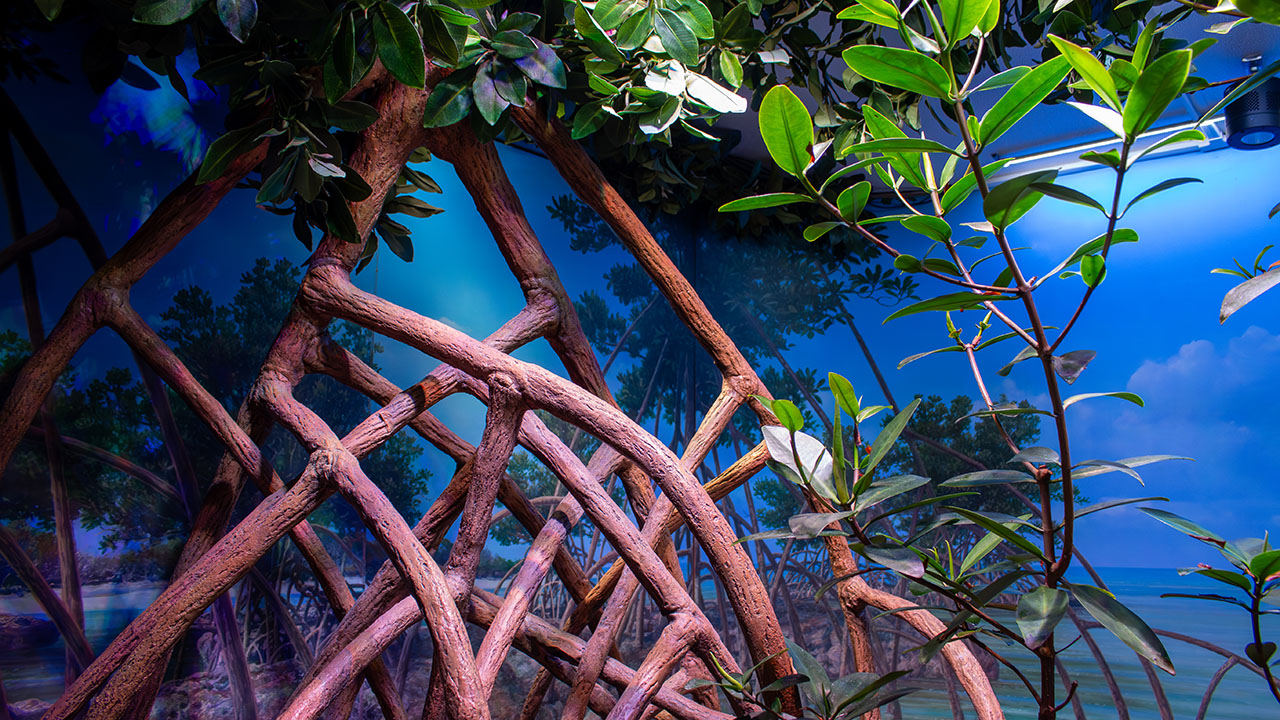
Mangroves protect people, too. Their roots may not grow deep, but they grow remarkably wide. All that intricate, interlocking structure grips the soil and holds shorelines in place, dramatically reducing coastal erosion.
When storms come in, those same roots break up wave energy before it reaches land. A community sheltered behind a healthy mangrove forest has a natural seawall working on its behalf. Mangrove forests also excel at pulling carbon out of the air, using some to grow and locking the rest away safely rather than letting it collect in the atmosphere, where it drives climate change. Scientists call this stored-away carbon “blue carbon.”
In the wild, mangroves are often removed for coastal development and shrimp farming. Protecting the forests we still have is always the first priority, but where mangroves have already been lost, restoration can give a coastline a second chance. Through our Marine Conservation Action Fund (MCAF), 2023 project leader Mark Ram, a lecturer at the University of Guyana, is studying the long-term impacts of mangrove restoration techniques in Guyana. His work measures blue carbon levels in replanted forests and the impacts of mangrove restoration on fish and other marine life.
Mangroves at the Aquarium
In the Yawkey Gallery, exhibits use realistic prop roots dipping into the water with small fish darting among them, showing exactly how animals shelter in the mangroves. Our Trust Family Shark and Ray Touch Tank is also landscaped with faux mangroves to mimic the animals’ natural habitat. And our Live Mangrove exhibit in the West Wing is home to real, living mangroves.
Growing tropical trees indoors in Boston isn’t easy. Mangroves need intense light, so the Live Mangrove exhibit has a full LED horticultural lighting system, including purple wavelengths tuned to fuel photosynthesis that run for several hours a day and UV lights that are essential for the trees’ growth. The lights ramp up and down over the course of a day and shift with the seasons to mimic a natural sun cycle.
A whole world in the roots
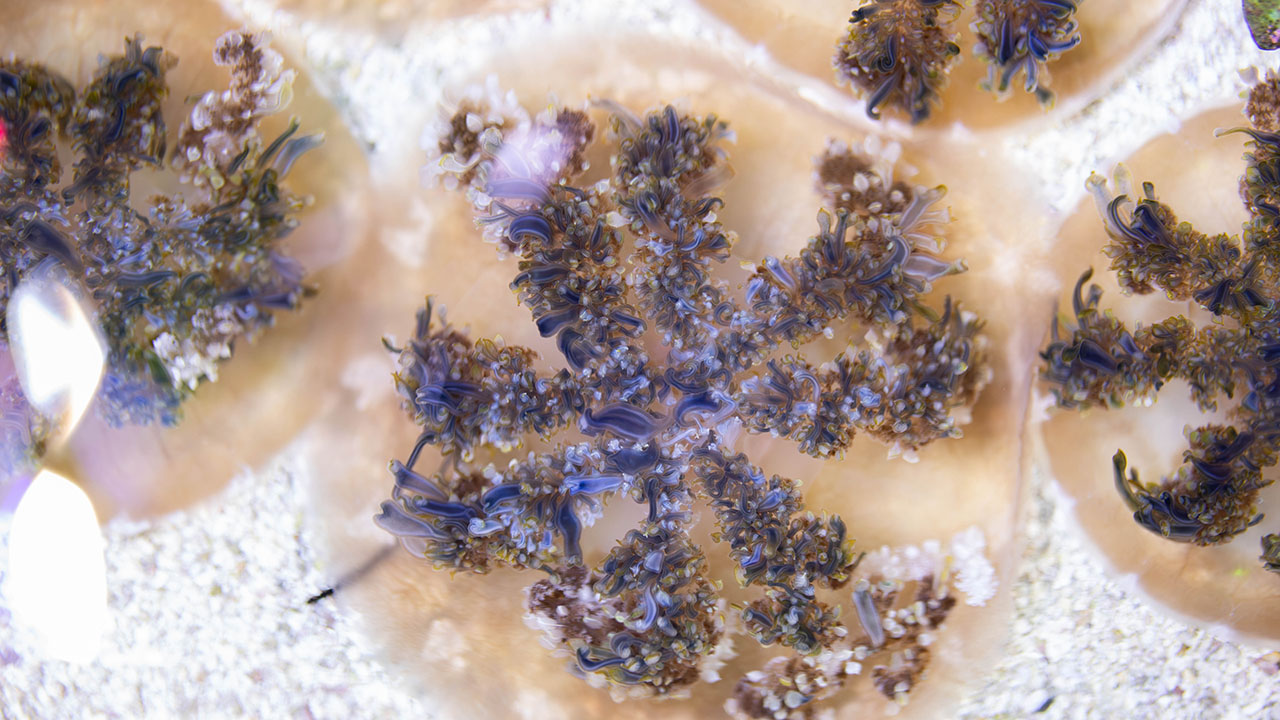
The Live Mangrove exhibit holds around 100 animals, but many are expert hiders, so it rewards a patient eye. The pajama, margarita, and red-spot cardinalfish are reliably out in the open, as are the upside-down jellies—mangrove dwellers that rest bell-down on the bottom, oral arms up, releasing a stinging mucus to catch food, while algae living in their tissues photosynthesize to feed them, much like a coral.
Look a little closer and you might see anemones, hermit crabs, or the bicolor blenny—black in front with a bright orange tail—who lives inside a snail shell. If you’re patient and a little lucky, you could also spot a shrimp goby, also known as a watchman goby, standing guard outside a burrow while its symbiotic partner, a pistol shrimp, does the digging.
The next time you visit the New England Aquarium, don’t walk past those unusual trees growing out of the water. Look closer, and you’ll see each one for what it truly is: a nursery, a seawall, and a carbon keeper, all in a single tree that adapted to live in the sea.

Related Stories

Protect the Blue Planet
Your ticket purchase to the Aquarium directly supports our work to create a vital and vibrant ocean for future generations.