PRESS RELEASE
Young right whale seen entangled in Gulf of St. Lawrence, a summer feeding area
Efforts underway to track whale as Aquarium prepares for summer field season

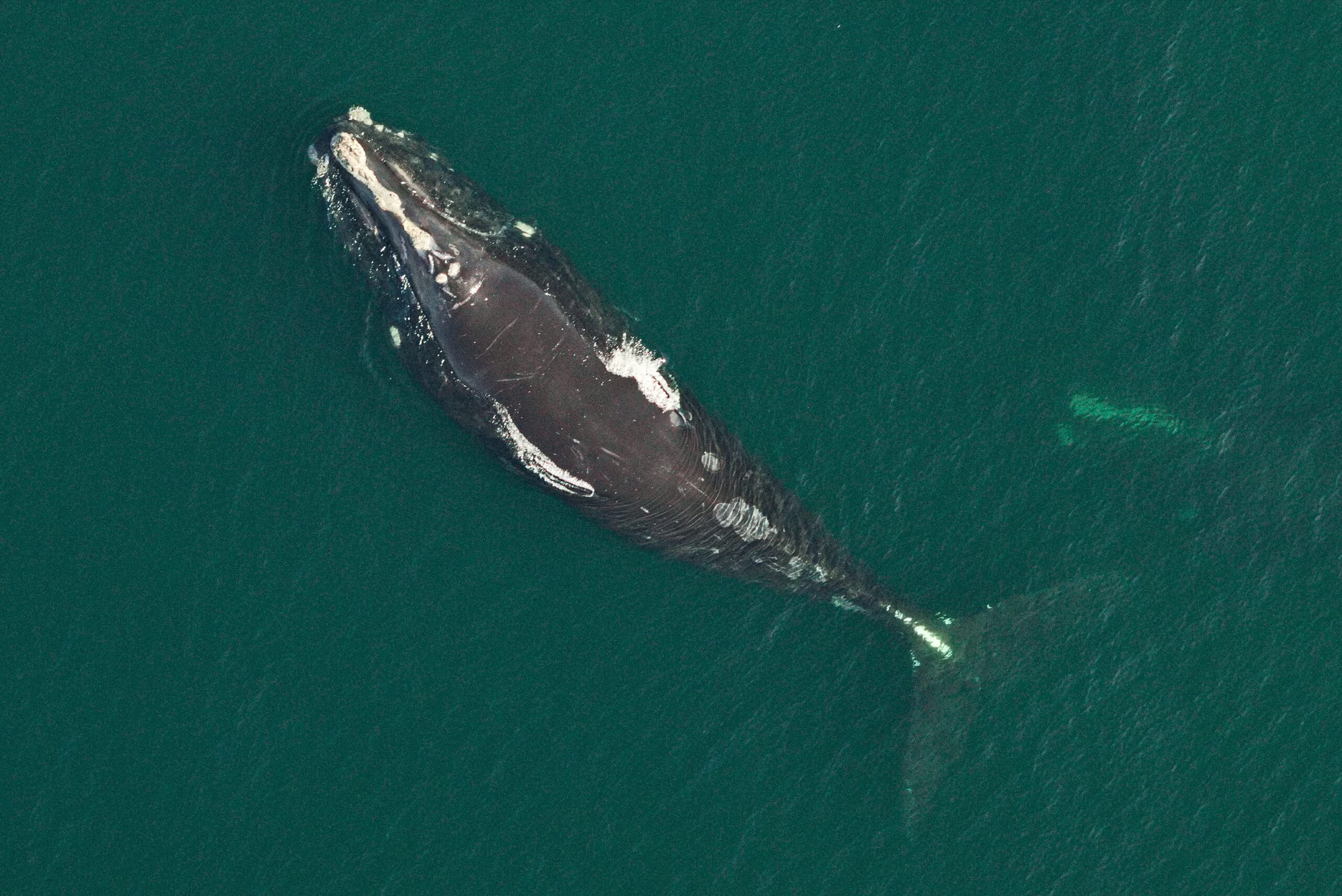
BOSTON, MASS. (June 12, 2026) – Responders are hoping to mount a rescue for a young right whale that was seen entangled in fishing gear in Canada’s Gulf of St. Lawrence, an important summer habitat for North Atlantic right whales where scientists will be conducting research in the coming months.
**PHOTOS OF RIGHT WHALE FROM APRIL 2026 AVAILABLE HERE WITH CREDIT TO NEW ENGLAND AQUARIUM**
The Department of Fisheries and Oceans Canada (DFO) reported that an aerial survey flight spotted the whale in the Gulf of St. Lawrence near Shippagan, New Brunswick, on June 8. Scientists in the Anderson Cabot Center for Ocean Life at the New England Aquarium confirmed the identification of the whale as Catalog #5192, an unnamed 5-year-old male. The whale was seen with fishing rope caught in its mouth and trailing several body lengths behind its body. Scientists said the whale’s behavior, wounds, and rope-rubbing marks indicate a very recent entanglement. This whale was last sighted without entangling gear in Cape Cod Bay, Mass., on April 21, 2026.
“It is always disheartening to hear the news of another entangled right whale, and Catalog #5192 is no different. As it appears this is a relatively recent entanglement, we are hopeful that rescue teams will be able to safely disentangle him so that the impacts of the event are minimized,” said Heather Pettis, Senior Scientist in the Aquarium’s Anderson Cabot Center.
DFO said attempts to relocate the whale are ongoing. The department hopes to attach a satellite tag to the entangling fishing gear to track the whale and potentially mount a disentanglement response if the weather and ocean conditions allow.
Catalog #5192 is the calf of “Millipede” (Catalog #3520) and the great-grandson of “Wart” (Catalog #1140), a well-known right whale with a large family tree. This marks the fourth entanglement event for Catalog #5192 and the first with attached fishing gear. Five other right whales have been documented with entanglement injuries in 2026.
“Catalog #5192’s story, unfortunately, is not unique. More than 86% of right whales have been entangled at least once and, like #5192, more than 60% have experienced multiple entanglements throughout their lives. There is no doubt that entanglements remain a persistent threat to this critically endangered species,” Pettis said.
Scientists with the Canadian Whale Institute and the Aquarium’s Anderson Cabot Center are spending time aboard joint research cruises this summer in the Gulf of St. Lawrence, examining all aspects of right whale activity in the habitat. The scientists will spend two weeks on the water from June into July and another two weeks in August to gather photo identification data, detect and document human-caused injuries including entanglements and vessel strikes, collect biological samples, perform health assessments via drone imaging, and test out new scientific technology. This is the 11th year the New England Aquarium has conducted research in the Gulf.
The Gulf of St. Lawrence in Canada is an important seasonal habitat for North Atlantic right whales. As climate change has driven right whales out of the traditional summer feeding waters in the Bay of Fundy, some whales are pursuing waters further north. Over the past several years, a third of the population has been found in the Gulf of St. Lawrence during the summer months.
North Atlantic right whales are one of the most endangered large whale species in the world, with an estimated population of about 380 and only 72 reproductive females. Entanglements and vessel strikes remain the leading causes of death and injury for North Atlantic right whales. Serious injuries and deaths of right whales caused by entanglements are preventable and highlight the importance of broad-scale adoption of ropeless or “on-demand” gear and weaker ropes.
MEDIA CONTACT: Pam Bechtold Snyder—psnyder@neaq.org