Please note: The Atlantic harbor seals will temporarily be off exhibit while we improve their habitat for their comfort and well-being.
5 Biological Artifacts That Bring the Ocean Closer
How our Interpretation and Engagement team uses a collection of more than 140 artifacts like teeth, bones, and shells to spark conversations.
By New England Aquarium on Wednesday, May 27, 2026

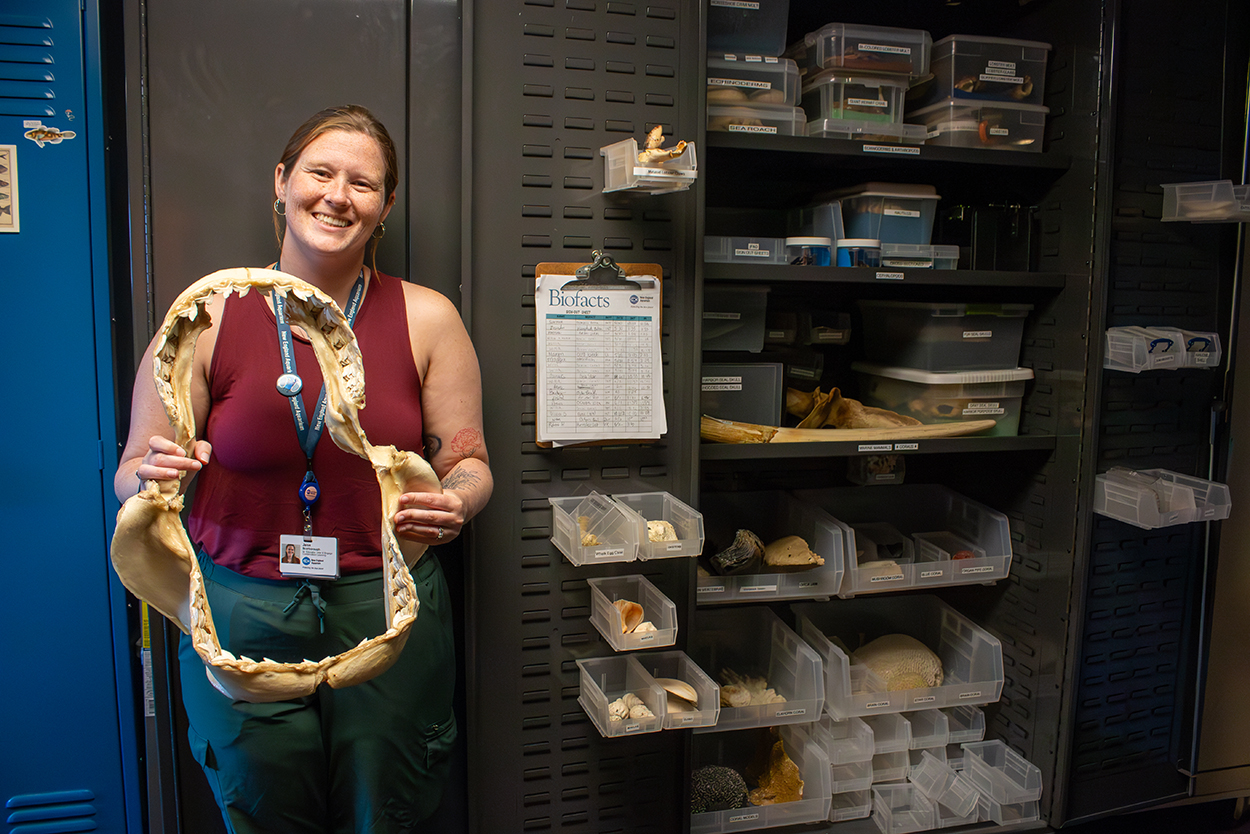
Biofacts—short for “biological artifacts”—are a collection of unique items the Interpretation and Engagement team uses to engage New England Aquarium guests in novel ways. A diverse array of items, from shells and shark teeth to animal care equipment, give guests a fresh perspective on marine life. They might learn, for example, that sea turtles’ shells are part of their skeleton, not something they can take on and off.
The team chooses from more than 140 active biofacts to bring onto the exhibit floor each day. Some are stationed at staffed carts in places like the Blue Planet Action Center and Exploration Station where they pair with specific activities. Others travel with educators who rove through the galleries, biofact in hand, ready to start a conversation wherever guests approach them.
“We’re focused on giving people an opportunity to interact with objects or parts of animals they usually don’t see, get to touch, or have any idea exist,” said Jenn Chamberlain, senior educator of informal interpretation. “They’re meant to be a little bit more hands-on, a little bit more experiential than just looking at an animal, especially if the animal that you’re looking for is not visible or it’s not in our collection.”
Below, Jenn shares five of their favorite biofacts you might run into on your next visit.
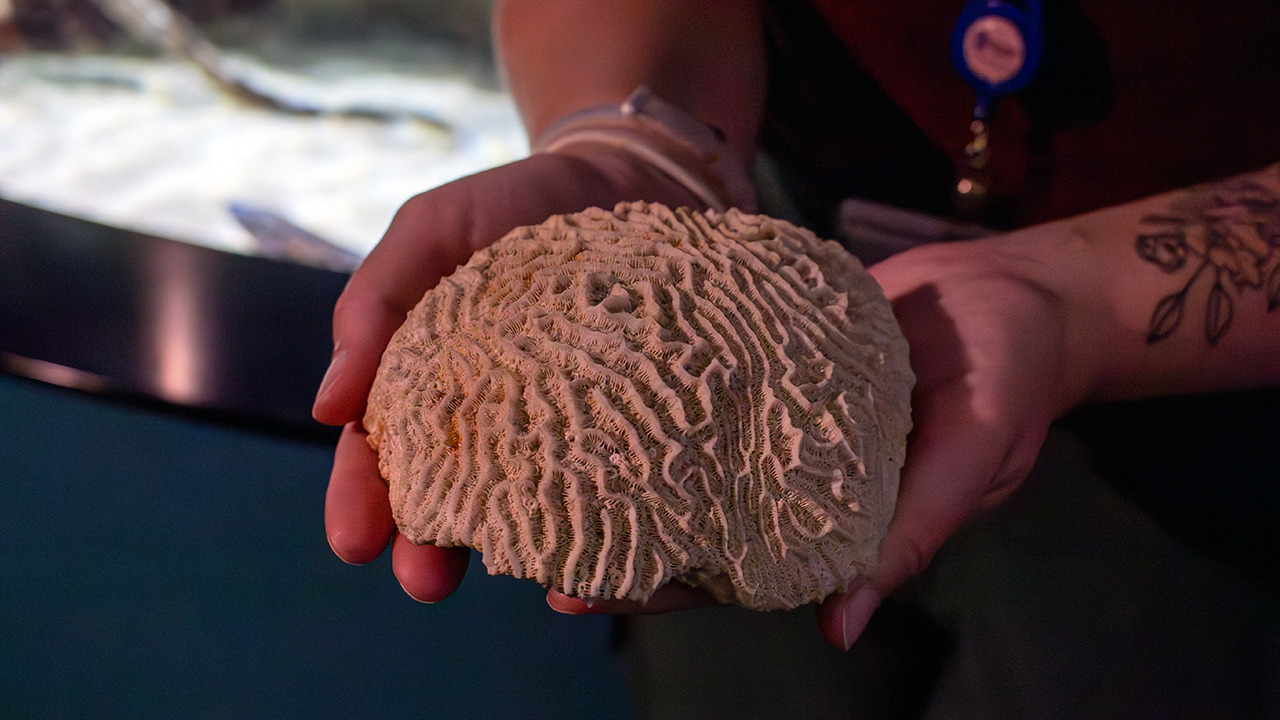
Brain coral
If there’s one biofact you’re most likely to encounter on a visit, it’s a piece of brain coral. In the first three months of 2026 alone, educators selected brain coral to bring to the Aquarium floor nearly 150 times.
“A lot of folks will use their opening line of, ‘Do you want to touch a coral skeleton?’” Jenn said. “Guests usually say something like, ‘I’m scared, but yes.’”
With its crevices and lobes, it’s clear where brain coral got its name. The biofact offers a tactile experience you can’t get through an exhibit window.
Because coral is such an essential part of ocean life, educators can talk about brain coral almost anywhere in the Aquarium. One particularly natural pairing is next to our Healthy Corals, Healthy Reefs exhibit, where live brain coral shows off vibrant pinks, purples, maroons, and greens. Positioning the two pieces of the same species next to each other can open important conversations about coral bleaching and ocean acidification.
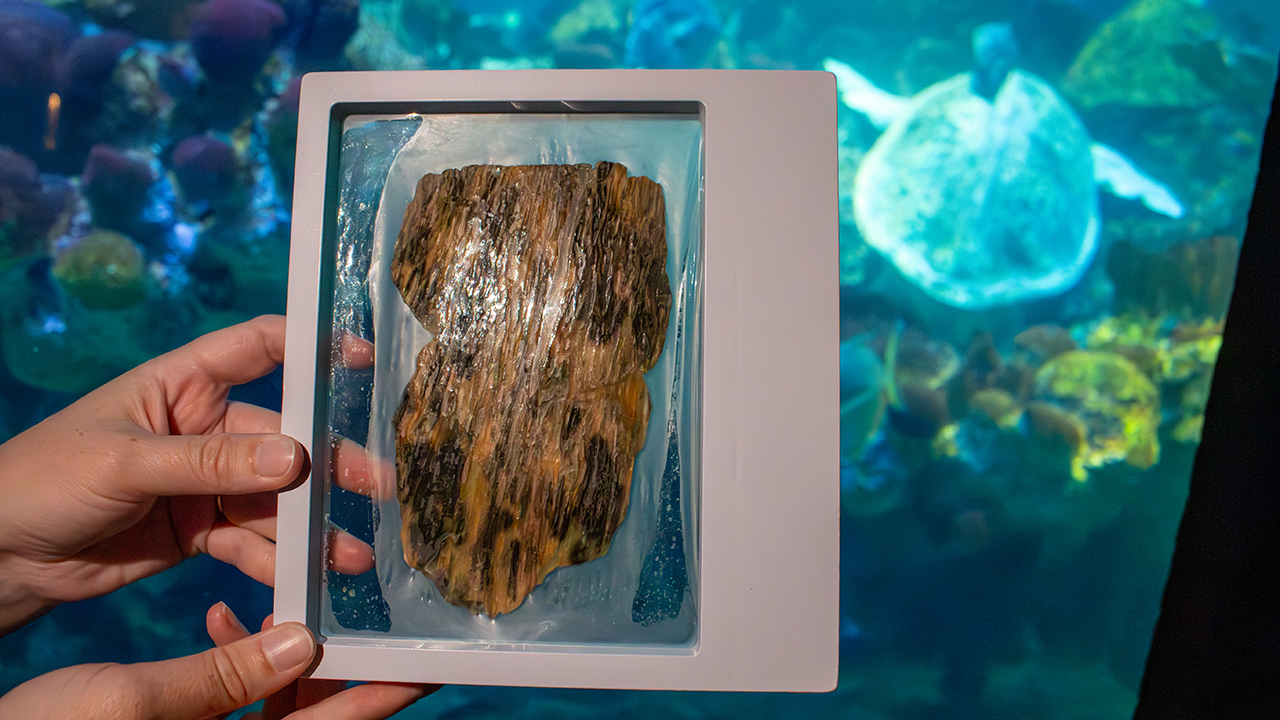
A piece of Myrtle’s shell
As Myrtle, the more than 500-pound green sea turtle, swims by in the Giant Ocean Tank exhibit, you might notice a scar on her shell.
That scar—and this biofact, a real piece of Myrtle’s shell—are the result of an infection that required surgery from our Animal Health team.
“It can be a really cool way to talk to [guests] about how we have a whole surgical suite here,” Jenn said. “We have a whole group of humans whose job is to take care of these animals if they are sick, in addition to the groups of humans who take care of them on a day-to-day basis.”
This biofact also helps dispel a common misconception: that turtle shells are simply armor. In reality, a turtle’s nerves are incorporated into their shell—which is why Myrtle needed anesthesia for this procedure and why she’ll seek out divers for a back scratch. The sensation is similar to if you scratch your fingernail, since shells and fingernails are both made of keratin.
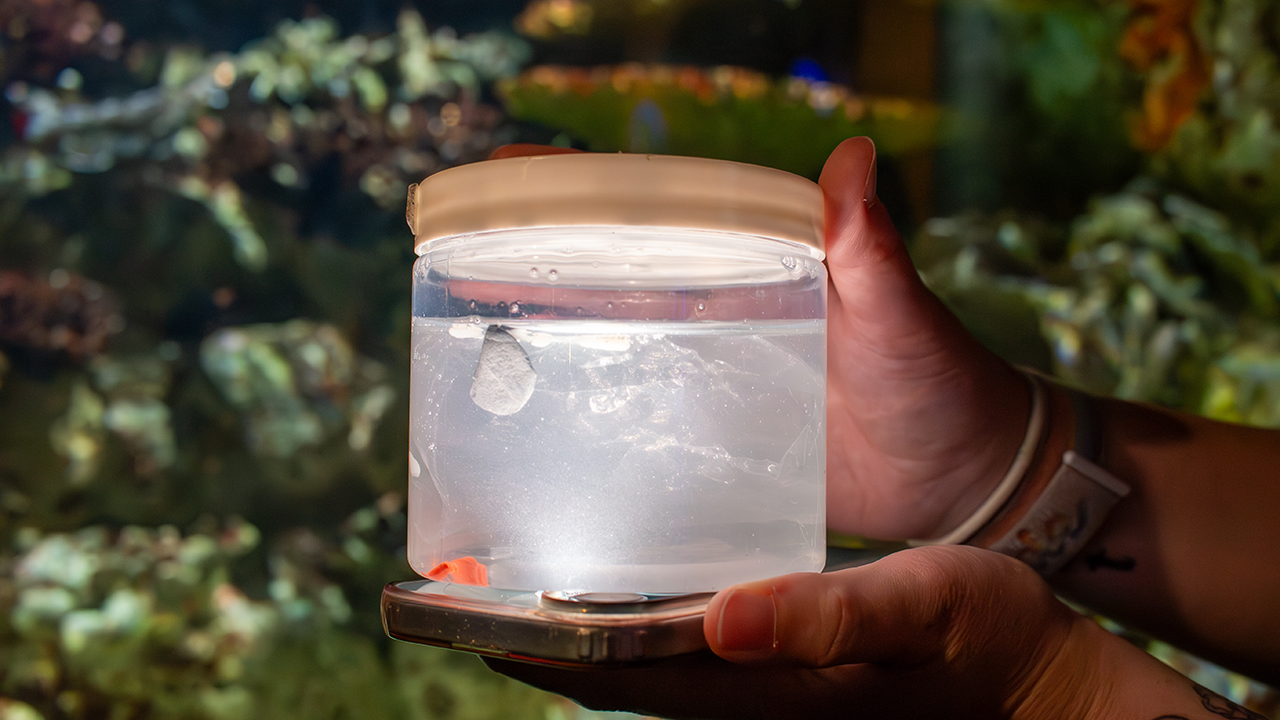
A jelly in a jar?
When guests first see this biofact, they usually ask if it’s a sea jelly in a jar. It is not. It’s actually plastic debris collected near Hawaii from the Pacific gyre, a system of rotating currents where ocean debris accumulates. In the low light near our sea jellies exhibit, though, the resemblance to a moon jelly is striking, which is the point.
“If this fooled you, it’s probably going to fool a turtle,” Jenn said. Sea turtles, especially leatherbacks, eat large quantities of jellies, and if they mistake plastic floating in the water for their favorite food, it can cause obstructions or leave them feeling full without the nutrients of a real meal. In extreme cases, they can starve with a full stomach if they ingest too much plastic.
Most guests already know about reusable water bottles and bags. Jenn likes to expand the conversation upstream—to where plastic is coming from, and how we might reduce the amount manufactured in the first place.
“We do need some single-use plastic for things like sterile medical supplies. What in your life is important enough that you want to save the plastic just for that?” Jenn often asks guests. “Plastic isn’t inherently bad. We like to talk about responsible use.”
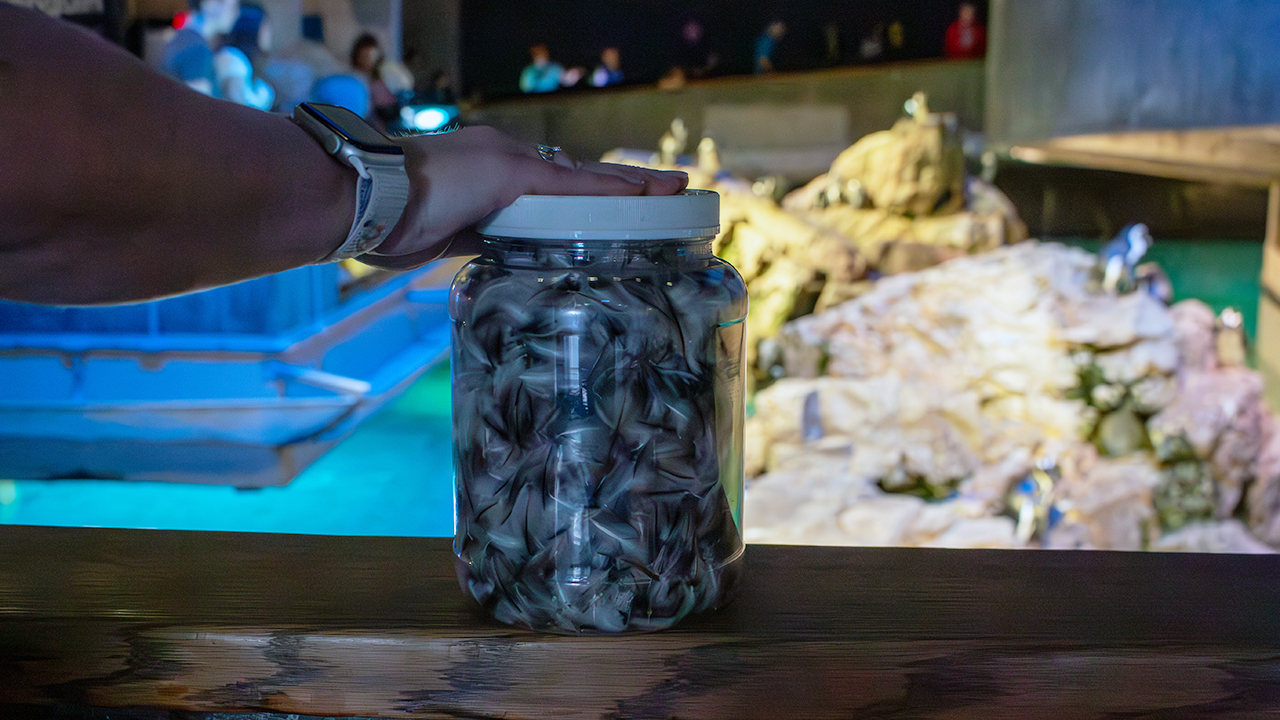
A jar of African penguin feathers
If you’ve visited during molting season and wondered why our penguins look a little scruffier than usual, you’re not alone. Jenn and their team hear that question daily during the four or five months of penguins’ “catastrophic molt” (a normal process, despite the dramatic name), when the birds shed and regrow their feathers all at once.
The feathers in the jar are surprisingly light and fluffy compared to the slick-looking plumage of a penguin in the water. Educators explain that penguins produce their own waterproof oil and spread it across their feathers by preening, creating a natural waterproof layer that insulates them in cold water. During the molting season, when they’re replacing worn feathers, they can’t swim long distances without that natural wetsuit in place.
The feather jar is also a natural entry point to broader discussions about overfishing and climate change, both of which affect the food supply penguins depend on during their molt.
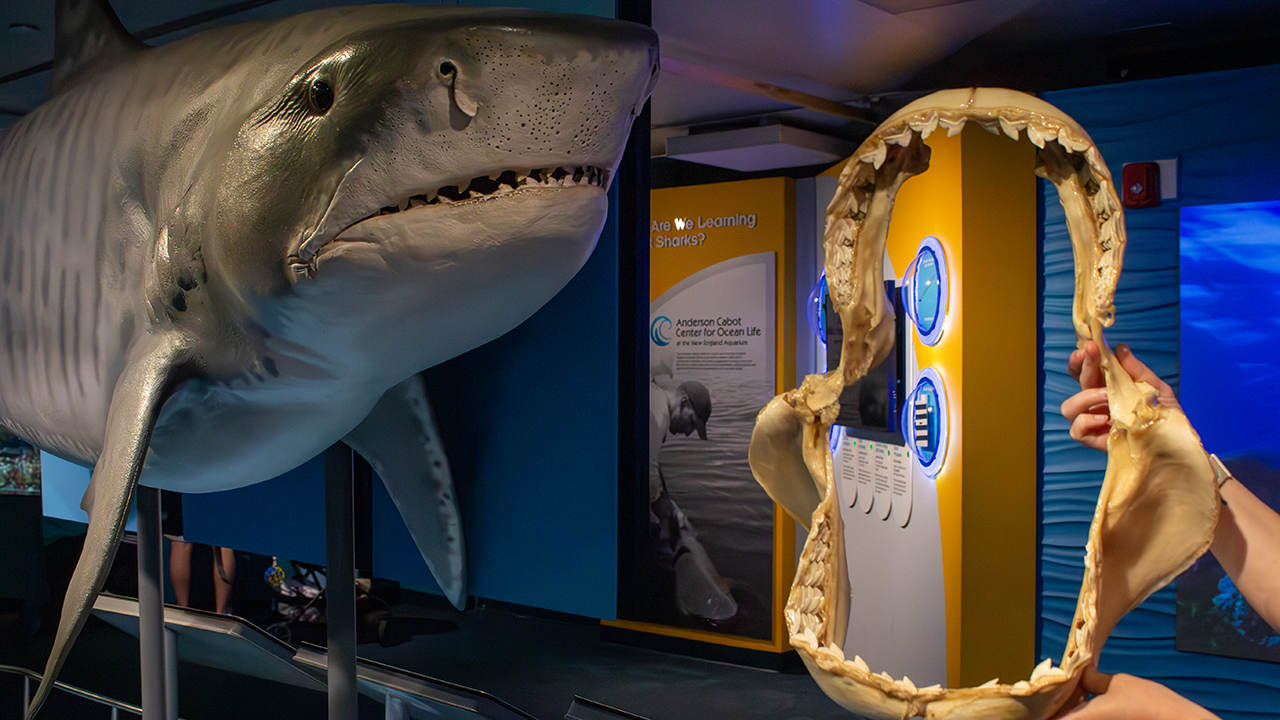
A tiger shark jaw
“Where are the big sharks?” is another common question that our educators get. Though roughly 80% of shark species are about four feet long or less, guests are usually most familiar with apex predator species like white sharks, tigers, hammerheads, and bull sharks.
This biofact helps tell the story of those larger sharks we don’t have on exhibit. Visitors can gently touch the teeth and see the additional rows behind them, which would have been ready to rotate forward as older teeth fell out.
“They’re like a shark tooth conveyor belt,” Jenn said. “Most species of sharks go through about 10,000 teeth in their lifetimes.”
Understandably, this is one of the most photographed biofacts in the collection. Guests are welcome to pose with their head in the middle of the jaws. It’s also a favorite of our teen interns, who find that the dramatic jaw makes talking with passersby easy.
Biofacts are a bridge between what guests see in our exhibits and the bigger questions behind them, the questions that can turn curiosity into ocean advocacy. They put something real in your hands, and trust you’ll take the conversation from there.
Plan your visit and keep an eye out for visitor educators in the galleries. You never know which biofact they’ll have in hand and what it might spark.

Related Stories

Every Visit Makes a Difference
Your ticket purchase to the Aquarium directly supports our work to create a vital and vibrant ocean for future generations.