Please note: The Atlantic harbor seals will temporarily be off exhibit while we improve their habitat for their comfort and well-being.
Year Six of Leatherback Sea Turtle Research in Puerto Rico Sees Record Tagging Numbers
The collaborative research effort between Anderson Cabot Center for Ocean Life staff and locally led conservation groups on the island is leading to better understanding of leatherback nesting behaviors.
By New England Aquarium on Tuesday, July 21, 2026

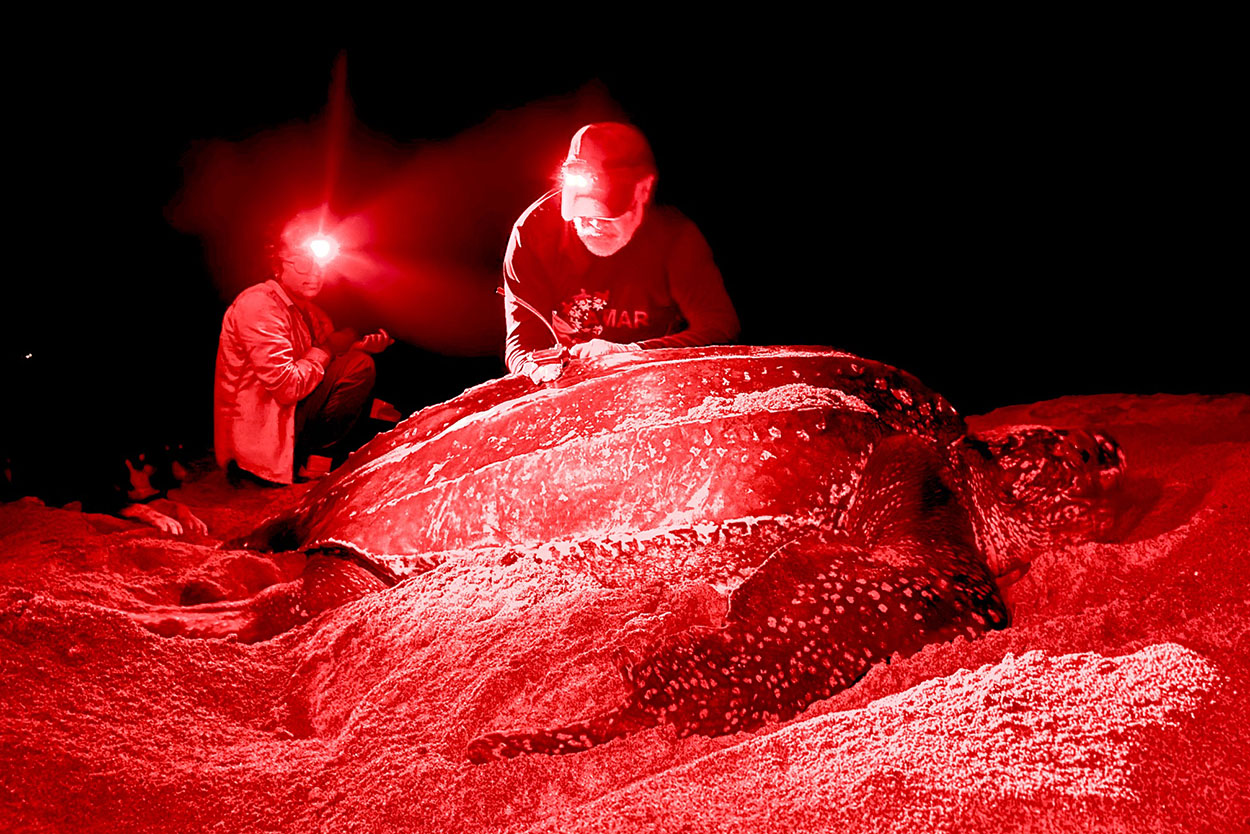
In late April and May, members of the New England Aquarium’s Anderson Cabot Center for Ocean Life and Rescue and Rehabilitation team traveled to Puerto Rico for their sixth field season of leatherback turtle research on the island.
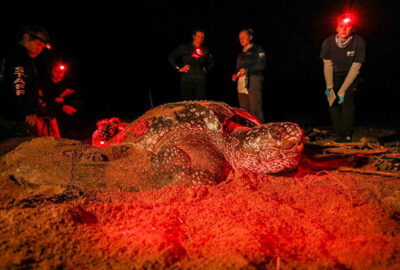
Working in partnership with community-led conservation groups across Puerto Rico, the team tags and tracks nesting leatherback turtles to better understand their nesting behaviors and movements in the Atlantic. It’s critical work as the population continues to face decline.
This year’s field season was “a smash,” said Dr. Kara Dodge, a research scientist who has led the project from its inception. “I feel like every year I say this, but it’s probably our most successful season to date,” Kara added.
Read on to learn more about their work!
Record number of turtles tagged
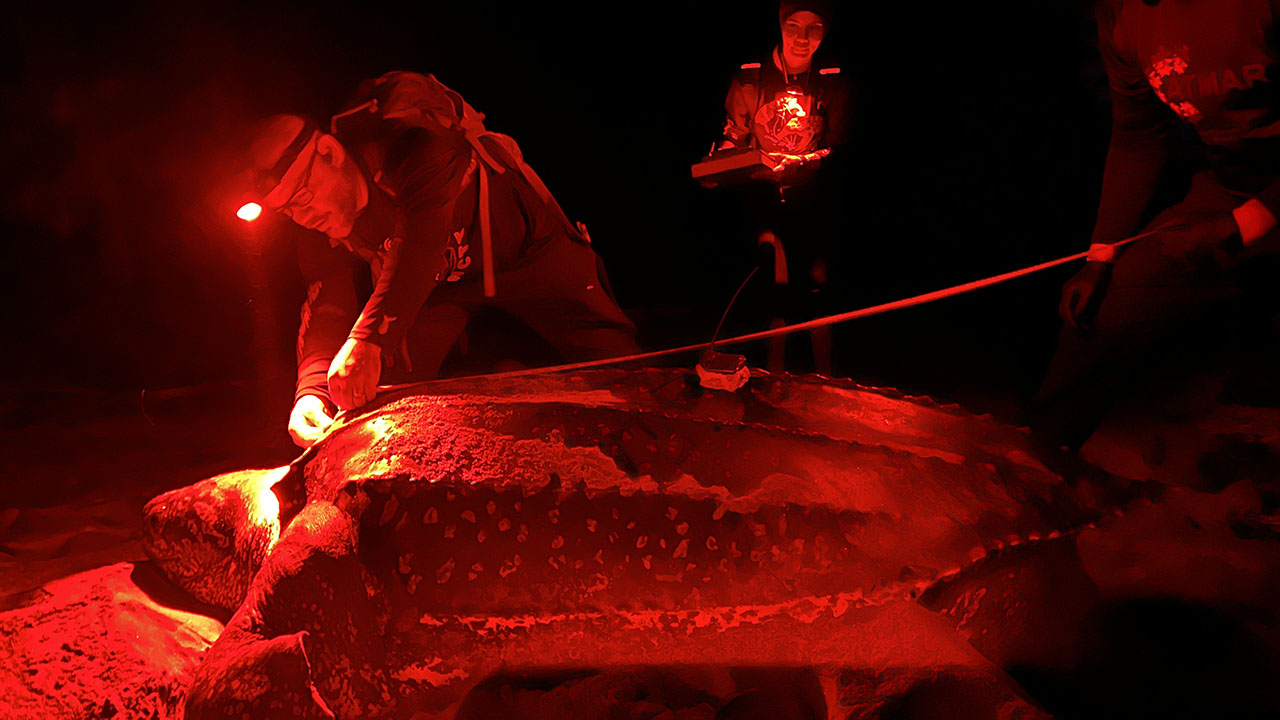
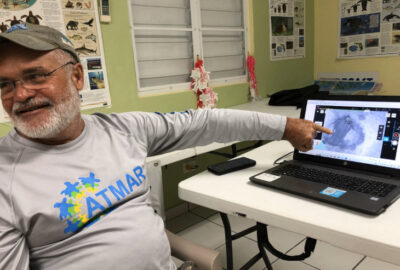
Leatherbacks nest at night—which means the team and volunteers are patrolling beaches looking for nesting turtles in the dark. To aid their search, they’ve relied on thermal drone surveys conducted by Luis Crespo, whose innovative work with Amigos de las Tortugas Marinas was initially supported by the Aquarium’s Marine Conservation Action Fund.
This year, the Aquarium acquired its own thermal drone and brought that capability in-house. The team continued to partner with Luis, who helped train Monica Zani, a research scientist and drone pilot with the Anderson Cabot Center’s right whale team, on the technology.
Since Luis first pioneered the use of thermal drones to locate nesting leatherbacks, other collaborators have adopted the method. As they traveled to other sites around the island, Kara and the team also collaborated with drone operators from Chelonia in Dorado.
“When we started flying at night, we were trying a new technique that others weren’t sure would work. Now other project sites are picking up the same technology,” said Crespo. “Having someone from the Aquarium team learn to fly alongside us this season means the technique keeps spreading, and it was full circle to work with the Aquarium, as they were extremely supportive of this work from the start.”
In total, the team sighted 26 nesting leatherbacks and tagged 23 turtles—four more than their previous record. “We saw some really interesting nesting behaviors in Dorado. We had, basically, the ‘new girls’ who had likely never nested before, and they were all over the north shore. They were really messy,” Kara said, laughing. “But then, the experienced nesters came back over and over to the same beach, which makes the group working there really happy. We are very interested in nesting dispersal, where individuals nest over a season. Sea turtle abundance estimates are often based on nest counts, but doing this with any accuracy requires an understanding of nest frequency and nest dispersal by individual turtles.”
The team also re-encountered five turtles that were previously satellite tagged in 2023 by the St. Croix Sea Turtle Project and in 2024 by our team, and were able to re-tag three of them.“Re-encountering turtles is really exciting,” Kara said. “It’s a fantastic opportunity for us to evaluate their health and growth, and to collect multi-year nesting and migration patterns for individual turtles.”
The three re-tagged turtles—Rowena, Mili, and Cattelya—are already on the move, their satellite tags transmitting data as they travel across the ocean. Mili’s tag shows the turtle heading back toward the Gulf of Mexico, which she also did in 2024, a migration pattern that had never before been observed in Puerto Rico leatherbacks.
“This information is essential for defining post-nesting migration pathways and foraging habitats,” Kara added.
A collaborative, knowledge -sharing effort
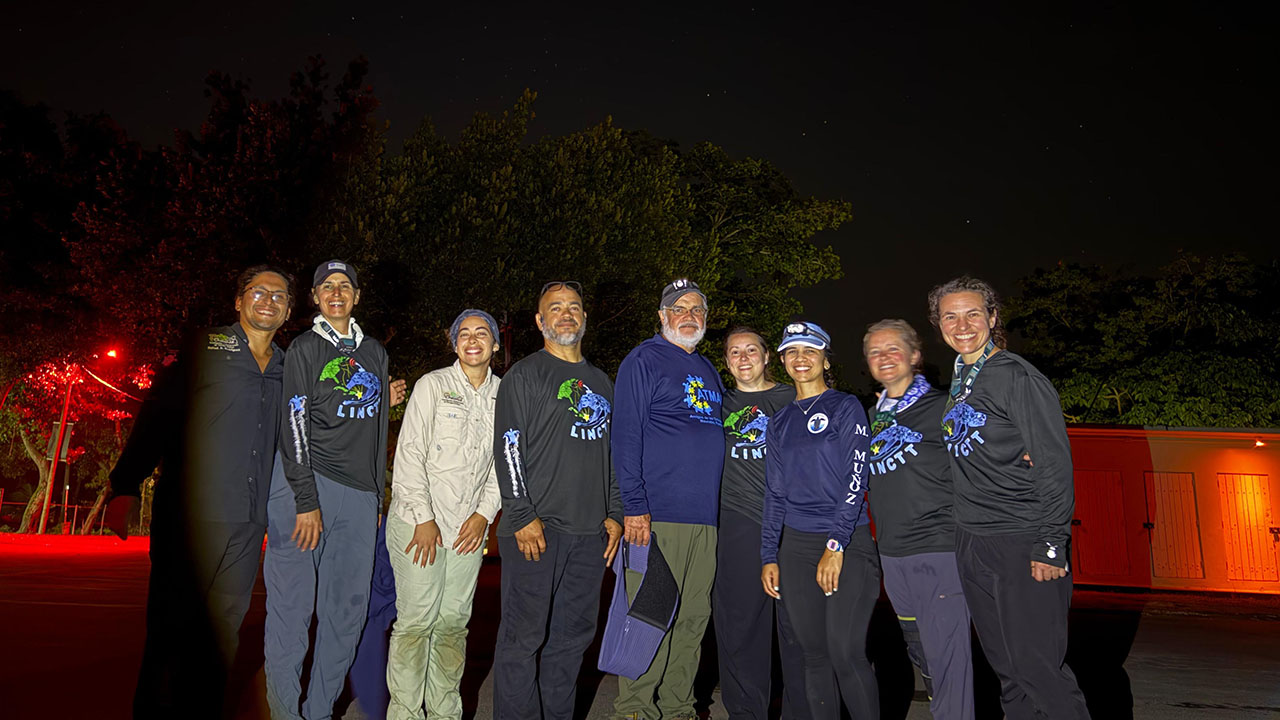
This season marked another milestone: an entirely local team worked together to tag the final turtle of the season after Aquarium staff departed in late May. A group of scientists from the Puerto Rico Department of Natural and Environmental Resources, El Pastillo Conservation Trust, Amigos de las Tortugas Marinas, and Tortugueros del Oeste attached a satellite tag to a nesting leatherback in Isabela on Puerto Rico’s north coast, the first time a leatherback has been tagged in this municipality. Isabela is an area where low leatherback nesting numbers have prevented focused tagging efforts. But, with local teams trained on deploying tags, there are now opportunities to expand to different tagging sites and identify other important areas for conservation.
“This continued work matters for understanding how experienced nesters and first-time nesters use the beaches differently at various sites, and it makes our collective team far more nimble when local partners can deploy tags independently and take advantage of opportunities at times and places outside of our typical tagging time periods,” Kara said. “Seeing our partners come together to tag a turtle after we left, on a beach we hadn’t even been monitoring, is exactly the kind of capacity that makes this work sustainable long after any one season ends.”
Looking ahead to what’s next
With six years of fieldwork now behind them, Kara and the team are looking ahead and excited about future possibilities. The team plans to return to nesting sites in Maunabo, Añasco, and Dorado, with potential to expand to new areas in 2027.
“We are now in a great position as a team, with three solid years of establishing logistics at each site, building relationships, training partners, incorporating new technologies, and collecting critical leatherback nesting and habitat use data,” Kara said. “We now have the capacity to expand our efforts to other areas of the island that are priorities for our partners. We hope that our data can be used to inform current US Fish and Wildlife Service deliberations on revising critical habitat designation for leatherback turtles in Puerto Rico, which will help protect these extraordinary turtles and their beaches for future generations.”
2026 Puerto Rico satellite telemetry research was conducted under DRNA Permits 2026-EPE-004, 2026-EPE-005, 2026-EPE-011, and 2026-EPE-015 (drone work).

Related Stories

Protect the Blue Planet
Your ticket purchase to the Aquarium directly supports our work to create a vital and vibrant ocean for future generations.