Please note: The Atlantic harbor seals will temporarily be off exhibit while we improve their habitat for their comfort and well-being.
Data Shows Loggerheads Treat New England as a Regular Feeding Ground
Kara Dodge, PhD, of the Aquarium's Anderson Cabot Center for Ocean Life explains what return migrations reveal about the importance of Cape Cod waters for this threatened species.
By New England Aquarium on Friday, October 23, 2026

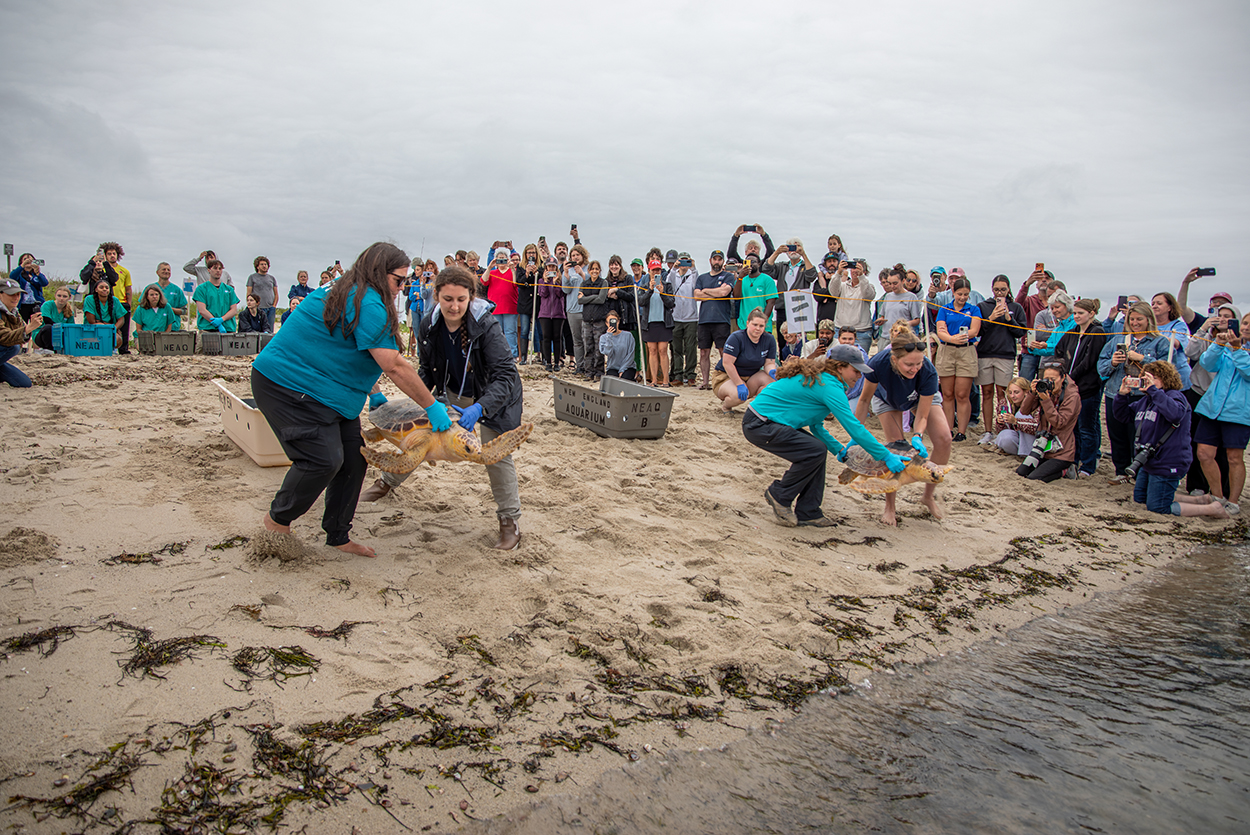
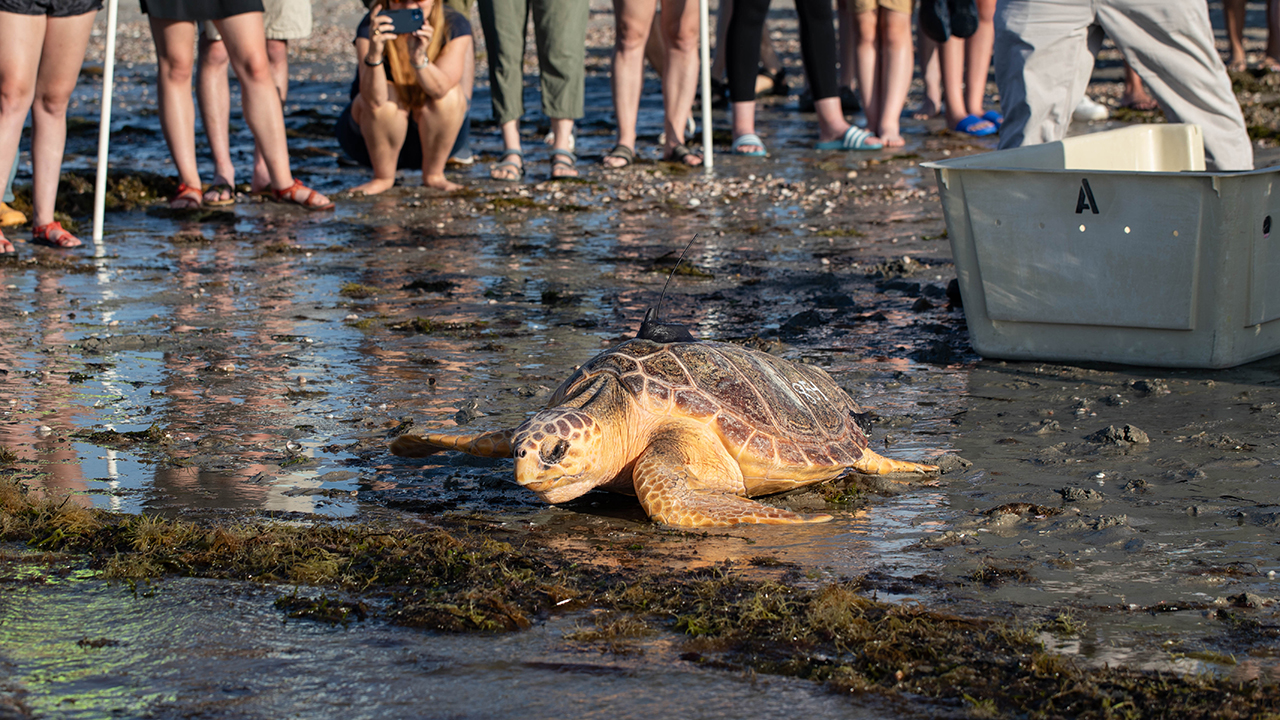
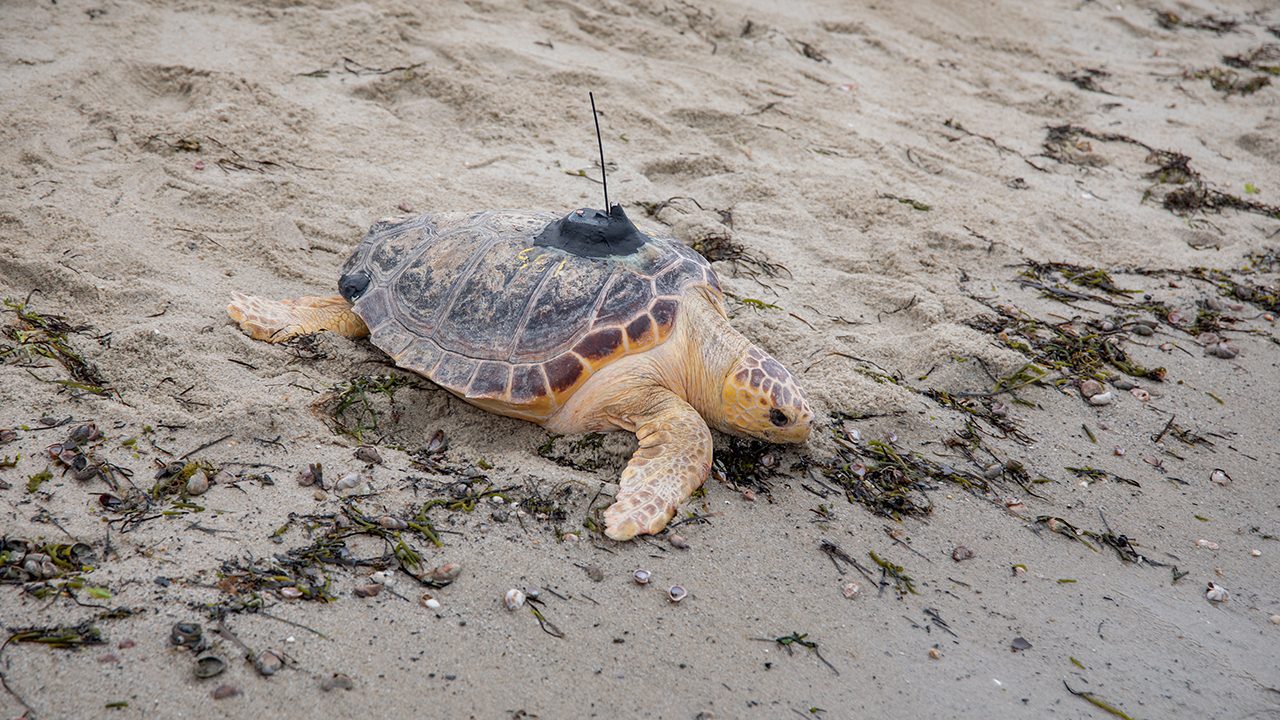
Eros, a loggerhead, was one of hundreds of sea turtles treated at the New England Aquarium’s Sea Turtle Hospital during the 2024 cold-stunning season. After months of recovery there (where all long-term patients that year received a name from Greek mythology), Eros was released from West Dennis Beach on Cape Cod in June 2025 with a second chance and a satellite tag on their shell.
That tag let researchers at the Aquarium’s Anderson Cabot Center for Ocean Life follow Eros as they fed in Nantucket Sound through the warm months, then headed south as the water cooled.
Then, our scientists watched Eros come back. The turtle worked their way slowly up the coast and settled in Nantucket Sound this summer—within a few miles of where they had been released a year earlier.
“Clearly that turtle, when it was released, found some good feeding habitat and remembered it,” said Kara Dodge, PhD, a research scientist at the Anderson Cabot Center for Ocean Life.
And Eros isn’t the only one. Using a combination of satellite tags and acoustic telemetry, Aquarium scientists have now documented seven loggerheads making this round trip. Two turtles returned at least two summers in a row. This kind of journey is called a return migration, and until this work, it hadn’t been documented in loggerheads this far north.
-
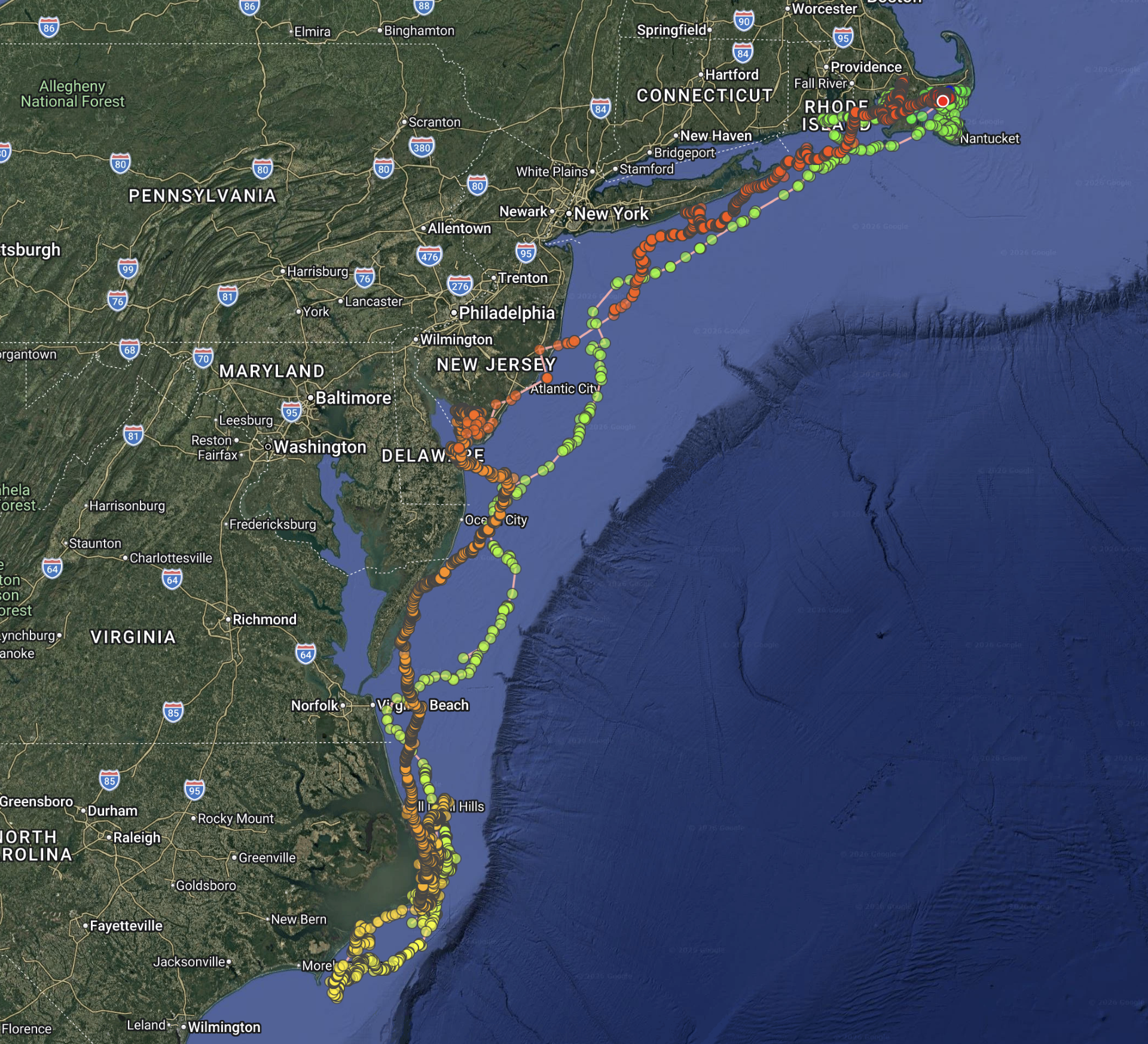
A map showing loggerhead sea turtle Eros' tracked locations along the East Coast Color scale for the locations (circles) is earliest to latest: green, yellow, orange, red -
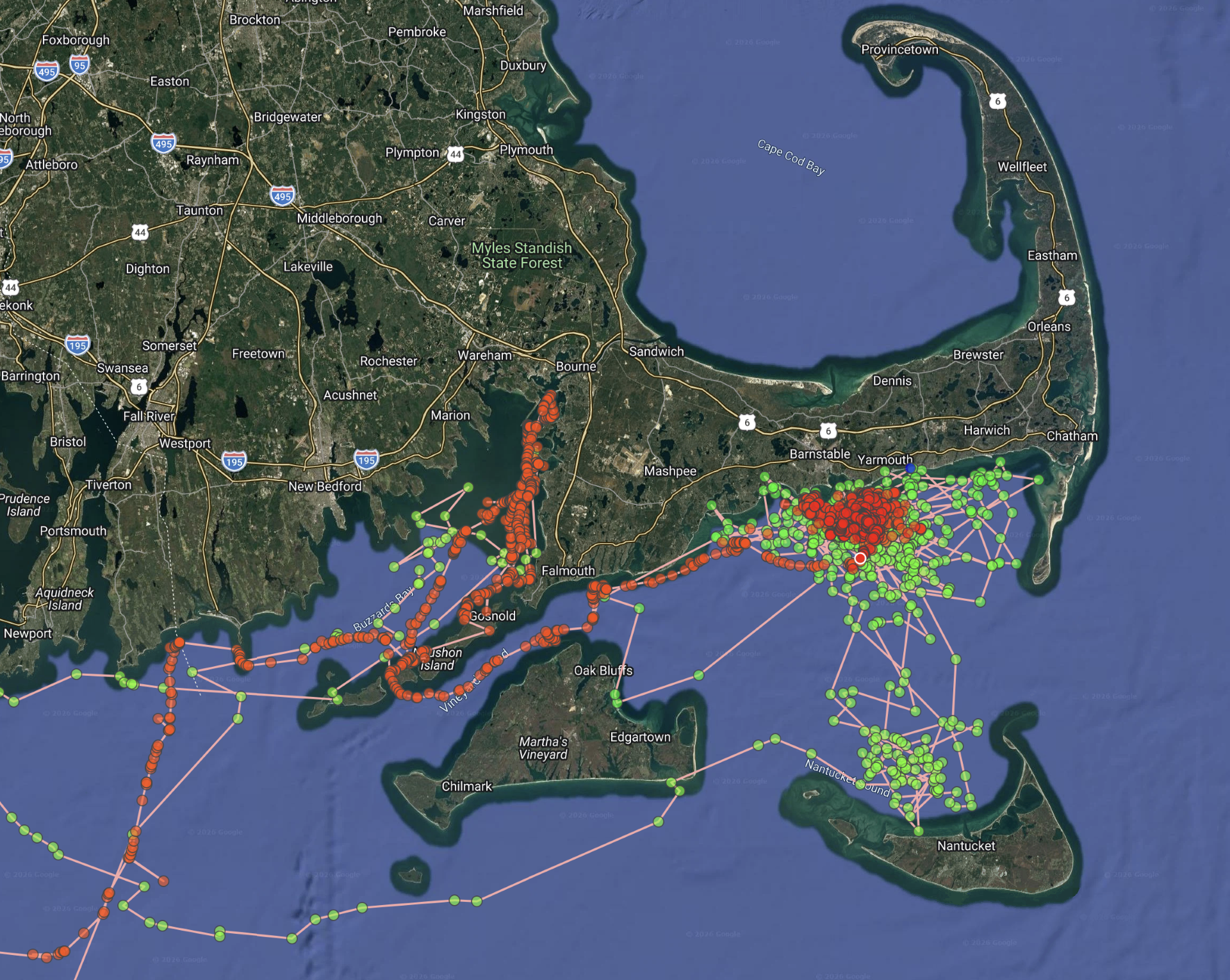
A map showing loggerhead sea turtle Eros' tracked locations around Cape Cod Color scale for the locations (circles) is earliest to latest: green, yellow, orange, red
/
A northern mystery
Many sea turtles return to the same feeding grounds year after year, a behavior scientists call foraging site fidelity. Loggerheads are known to show it in places like Chesapeake Bay and the Gulf of Mexico. But New England was an open question. Our waters sit at the northern edge of the loggerhead’s range, and researchers weren’t sure whether it was a regular stop or a one-time visit for the turtles that travel this far.
The Anderson Cabot Center’s tracking tags showed that at least some loggerheads do come back, and go out of their way to do so. To return from southern waters where they spend the cooler months, turtles swim right past well-established feeding grounds like Chesapeake Bay and Delaware Bay.
“What that suggests to me, from an ecological standpoint, is that we have sufficient resources here, and they’re reliable enough that these turtles are making a longer migration to come back and feed in these same habitats,” Kara said.
Returning to the same feeding ground after a trip of hundreds of miles takes serious navigation skills, and turtles likely rely on a variety of cues to find their way. Research suggests sea turtles can orient using chemosensory cues, features of the seafloor, Earth’s magnetic field, and the angle of the sun at sunrise and sunset, depending on where they are.
During her PhD work, Kara studied how leatherback turtles orient during open-ocean migrations. “The data I collected was visually jarring,” she said. “It looked like they were all swimmers in an Olympic pool, swimming in adjacent lanes, going in the exact same direction, across the open Atlantic.”
Keeping tabs (and tags) on return travelers
The biggest hurdle in understanding return migration to New England has been the tags themselves. Documenting a return migration means following one turtle for a full year, and most turtle-tracking tags don’t last that long. Satellite tags are attached to a turtle’s shell and send their location in near-real time. But their batteries run down, and young, fast-growing turtles often shed them, so most stop transmitting well before a year.
Anderson Cabot Center scientists’ recent success in tracking loggerheads is partly due to an increased tagging effort. By equipping more turtles than ever with tags, they raised the odds that a few tags would last unusually long. Eros’s tag was one of the lucky ones that stayed on, transmitting for more than a year before it went quiet.
Kara and her team also use acoustic tags, which work more like an ocean E-ZPass. Each transmitter sends out a unique ping, and underwater receivers log any tagged animals that swim within range. In 2021 and 2022, Anderson Cabot Center scientists and Aquarium veterinarians implanted acoustic transmitters in two groups of rehabilitated loggerheads, a new technique for sea turtles. Internal tags can’t be shed and their batteries last for years. The tradeoff is patience. Receivers have to be pulled from the water for their data to be downloaded and shared. Within a couple of years, scientists saw that the 2021 and 2022 turtles began turning up again in Buzzards Bay, the Cape Cod Canal, and Nantucket Sound.
Understanding loggerheads’ migration patterns isn’t just interesting, it matters for conservation. When turtles return to the same feeding grounds year after year, it signals that those places may require focused conservation efforts and prioritization in ocean management plans. “Foraging site fidelity is an important finding,” Kara said. “Returning suggests this area has consistent, high-quality food sources such that loggerheads are willing to swim farther, expend more energy, and make that extra push to get to it.”
What’s next
The next big question is how many turtles come back. For now, each return migration is a valuable but scattered data point. And tags with the longest battery life are too large for species like Kemp’s ridley and green sea turtles, which tend to be younger and smaller than the loggerheads that visit New England.
Kara hopes smaller, longer-lasting tags will change that, and she’s optimistic those tags could be created soon. “Technology is booming right now and there’s so many innovators out there,” she said. “With better tags, we could really consistently see what these turtles are doing and what percentage of these turtles are returning…We’re just starting to build that data, and it will be exciting to be able to hopefully use improved and longer-lasting tags to answer these questions.”
Follow along!
You can follow some of our tagged turtles too on the Aquarium’s Sea Turtle Tracker. Tap a turtle’s name to see its species and whether it was tagged on a nesting beach, following rehabilitation, or after an entanglement.

Related Stories

Every Visit Makes a Difference
Your ticket purchase to the New England Aquarium directly supports our work to create a vital and vibrant ocean for future generations.