Tickets for Saturday, 8/22, are sold out both online and in person. Tickets for Sunday, 8/23, are still available!
PRESS RELEASE
Aquarium researchers complete most successful leatherback sea turtle tagging season to date in Puerto Rico, aided by thermal drone technology
Team applies 23 satellite tags across four nesting beaches

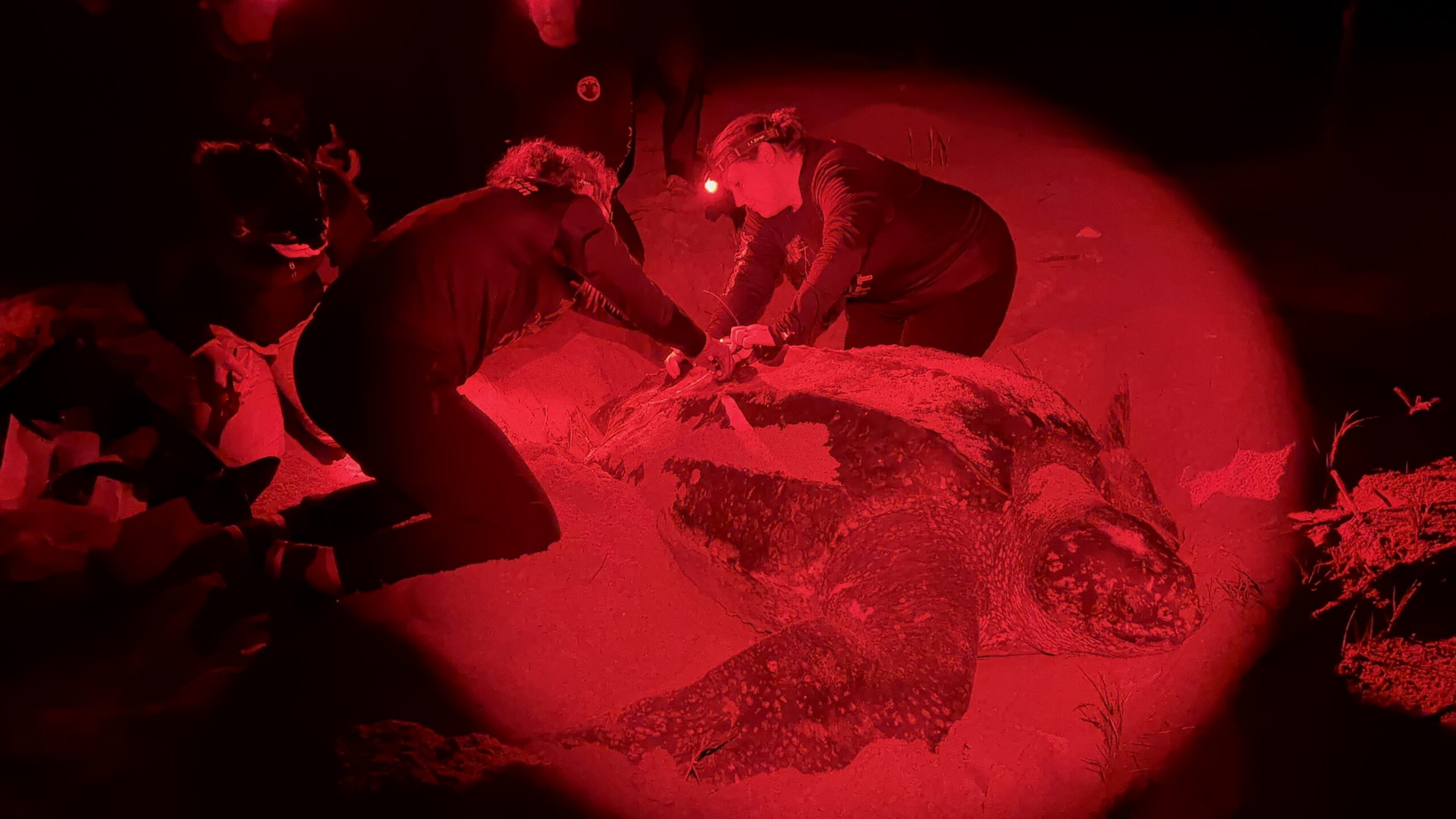
BOSTON, MASS. (August 6, 2026) — New England Aquarium researchers wrapped up their most successful leatherback sea turtle tagging season to date this spring in Puerto Rico, applying 23 satellite tags across four nesting beaches and confirming more than 90 nests through tag data. The team used a thermal-imaging drone purchased specifically for the project, marking a shift in how researchers monitor a species that nests along long, difficult-to-patrol beaches.
*PHOTO AND VIDEO AVAILABLE WITH CREDIT AND PERMIT INFORMATION*
The project, now in its sixth year, is led by Dr. Kara Dodge, Research Scientist in the Aquarium’s Anderson Cabot Center for Ocean Life. Puerto Rico hosts the highest concentration of leatherback nesting activity in the United States, and the Aquarium’s team collaborates with a network of local partners each season to tag nesting females and track their movements after they return to sea.
In prior seasons, the team relied on drone surveys flown with guidance from longtime partner Luis Crespo, founder of the Puerto Rico-based nonprofit Amigos de las Tortugas Marinas (ATMAR), who has spent more than 25 years protecting sea turtle nesting beaches in the region, to test whether the technology could reliably support nightly monitoring. Crespo, a pioneer of this work, became a New England Aquarium Marine Conservation Action Fund (MCAF) Project Leader in 2023 and used the accompanying grant to acquire the first thermal drone deployed on these beaches.
This season, the Aquarium acquired its own thermal drone and brought that capability in-house. Monica Zani, Research Scientist in the Aquarium’s Anderson Cabot Center who has spent years training on drone-based biological sample collection with North Atlantic right whales, spent two field nights working alongside Crespo to learn how to use drones in this capacity. After gaining local knowledge on night thermal flying over an active nesting beach in Puerto Rico, she served as drone pilot this season.
“When we started flying at night, we were trying a new technique that others weren’t sure would work. Now, other project sites are picking up the same technology,” said Crespo. “Having someone from the New England Aquarium team learn to fly alongside us this season means the technique keeps spreading, and it was full circle to work with the Aquarium, as they were extremely supportive of this work from the start.”
“Luis is a pioneer for this type of work, and working alongside his team taught me so much about reading the beach through this technology,” said Zani. “He built this technique from scratch when nobody knew if it would work, and it shows in how efficiently his team operates now.”
Leatherbacks nest across miles of beach that are challenging to patrol on foot every night, and some nesting females can go undetected. The thermal drone allows researchers to survey in minutes what used to take a beach-walking team hours, greatly increasing the likelihood of intercepting and identifying every nesting female in a given night.
The team also re-encountered five turtles that were previously satellite tagged in 2023 and 2024 and were able to re-tag three of them. The three re-tagged turtles, named Rowena, Mili, and Cattelya, are already on the move post-nesting, their satellite tags transmitting data as they travel across the ocean. Mili’s tag shows the turtle heading back toward the Gulf of Mexico, which she also did in 2024, a migration pattern that had never before been observed in Puerto Rico leatherbacks. This information helps researchers define post-nesting migration pathways and foraging habitats to further support their conservation efforts.
The season also marked a knowledge sharing milestone: After Aquarium staff departed, a team of local partners worked together to tag a turtle in Isabela, a new area where low leatherback nesting numbers has prevented previous tagging efforts.
“This continued work matters for understanding how experienced nesters and first-time nesters use the beaches differently at various sites, and it makes our team more nimble when local partners can deploy tags independently,” said Dodge. “Seeing our partners come together to tag a turtle after we left, on a beach we hadn’t even been monitoring, is exactly the kind of capacity that makes this work sustainable long after any one season ends.”
2026 Puerto Rico satellite telemetry research was conducted under DRNA Permits 2026-EPE-004, 2026-EPE-005, 2026-EPE-011, and 2026-EPE-015 (drone work).
For more information about the New England Aquarium’s sea turtle conservation work, visit https://www.neaq.org/animal/turtles/.
MEDIA CONTACT: Pam Bechtold Snyder—psnyder@neaq.org