Please note: The Atlantic harbor seals will temporarily be off exhibit while we improve their habitat for their comfort and well-being.
PRESS RELEASE
In surprise sighting, previously unknown North Atlantic right whale calf is spotted in Canadian waters
Aquarium scientists determine calf is 24th likely born during calving season

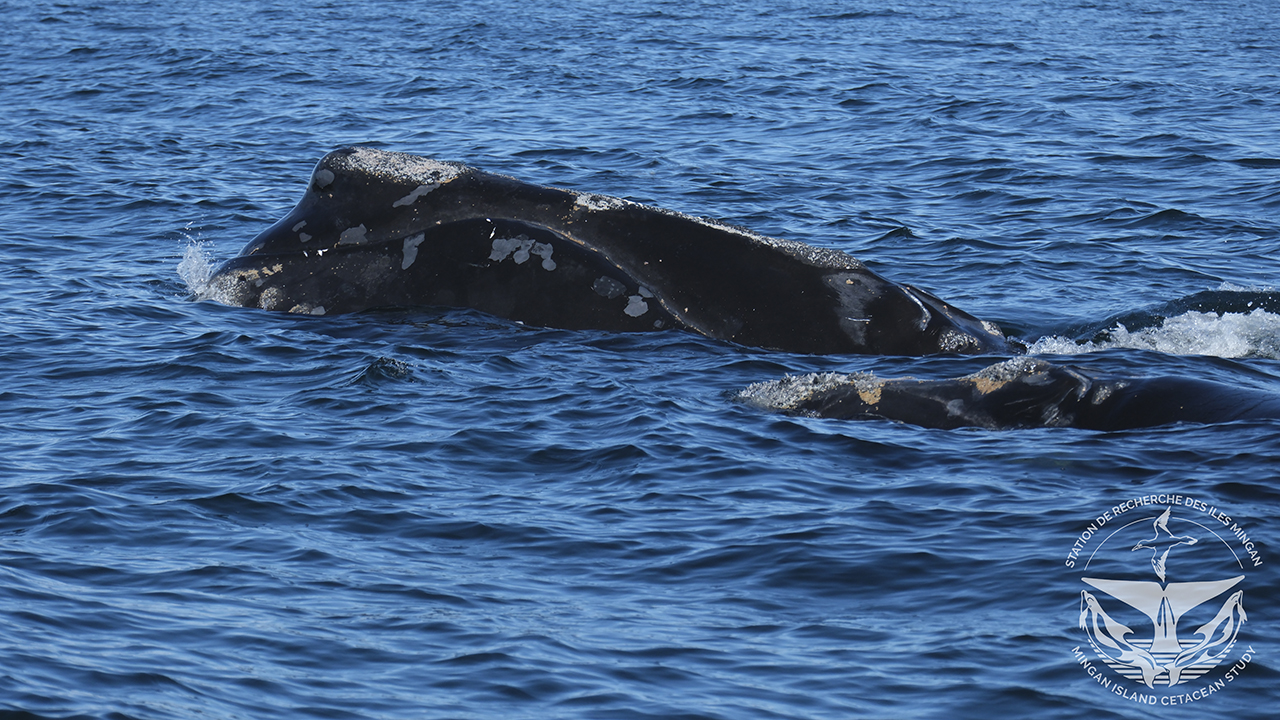
BOSTON, MASS. (Nov. 2, 2026) – Months after the North Atlantic right whale calving season ended, researchers have identified a previously unknown mother-calf pair that was recently spotted in Canadian waters.
On Sept. 25, Mingan Island Cetacean Study researchers captured images of a right whale mother with a calf near Anticosti Island, Quebec. Those photos were shared with scientists in the New England Aquarium’s Anderson Cabot Center for Ocean Life who manage the North Atlantic Right Whale Catalog, an extensive photo-identification database. After weeks analyzing sighting data and comparing photos, the scientists determined that this was a new calf likely born during the 2025–2026 calving season that had gone unseen in winter surveys. Its mother, identified as “Silt” (Catalog #1817), is at least 38 years old and has now given birth to six known calves in her life.
“Silt was briefly seen in the southeastern U.S. calving grounds in February 2026, so it’s possible she had the calf there but snuck away before they were documented together. This is an exciting discovery for us so late in the year,” said Amy Warren, a scientist in the Aquarium’s Anderson Cabot Center.
Silt hadn’t been seen since the February sighting, managing to elude boat-based and aerial surveys along the East Coast in the spring and summer until now. In addition to her six calves, Silt also has three grandchildren, and her first great-grandchild was born this year. She has survived at least five fishing entanglement events, some leaving her with substantial scarring on her head and tail. Her family has also experienced many injuries, and some have not been as lucky as Silt. Her 2022 calf, Division (Catalog #5217), succumbed to a severe entanglement earlier this year, and her eldest, Catalog #2617, died in 2005 after being struck by a vessel. Scientists hope to document this new calf more and that it avoids the hazards facing right whales in the ocean.
The annual calving season in the southeastern United States, which runs from mid-November until mid-April, produced 23 mother-calf pairs, the fourth-highest count ever. The recent calf sighting brings that total to 24. It’s positive news for a critically endangered species with an estimated population of about 380 that faces ongoing threats including fishing gear entanglements and vessel strikes.
In collaboration with a network of individuals and research organizations along the eastern Atlantic seaboard and eastern Canada, scientists in the Aquarium’s Anderson Cabot Center curate the North Atlantic Right Whale Catalog, which allows them to track right whales’ life stories including births, injuries, migration patterns, and age to create detailed histories of each individual whale. Scientists use this information to create a detailed list of mom-calf pairs with biographical information each calving season. This past season’s list is available on the Aquarium’s website.
MEDIA CONTACT: Pam Bechtold Snyder—psnyder@neaq.org