Please note: On Tuesday, November 10, the Aquarium’s West Wing will be closed for exhibit maintenance.
The Atlantic harbor seals will temporarily be off exhibit while we improve their habitat for their comfort and well-being.
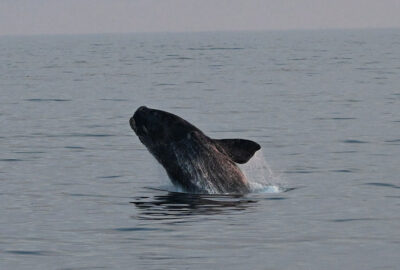
Pedigree-Informed Abundance Estimation for the Endangered North Atlantic Right Whale (Eubalaena glacialis) via Gametic Mark-Recapture
By Timothy R. Frasier, Brenna A. Frasier, Sonya N. Radvan, Moira W. Brown, Philip K. Hamilton, Lisa A. Conger, R. Clay George, Katharine A. Jackson, Scott D. Kraus
Originally published in Marine Mammal Science in January 2026

Abstract
Pedigrees can provide important data for abundance estimation by providing a means to infer the presence of individuals that might otherwise not be detected. Such information may be particularly important for endangered species, where the addition or removal of just a few individuals can make the difference between population growth and decline. Here, we use gametic mark-recapture methods to incorporate pedigree information into male abundance estimates for the endangered North Atlantic right whale (Eubalaena glacialis)—a species for which there is conflicting information: some data suggest that almost all individuals have been identified by photo-identification efforts and are therefore accounted for, whereas other data suggest that a substantial number of individuals may not be identified and are therefore “missing” from abundance estimates. Our pedigree analyses did not infer a large number of North Atlantic right whales that were unaccounted for in the photo-identification data, suggesting that the photo-identification catalog is representative of the species as a whole and that abundance estimates based on those data are accurate.
Full Text
- Read at Marine Mammal Science
Affiliated Authors



Related Stories
Research That Drives Action
Through pioneering conservation research and strategic partnerships, our team of 40 scientists at the Anderson Cabot Center for Ocean Life works to combat the unprecedented impacts on the ocean from climate change and other human activities.
