Please note: The Atlantic harbor seals will temporarily be off exhibit while we improve their habitat for their comfort and well-being.
Building the Tools to Study Vessel Strikes, a Leading Threat to Right Whales
Supported by a partnership dating back nearly 30 years with Irving Oil, a pilot study in Cape Cod Bay is testing ways to measure how whales respond to approaching boats and ships, work that could improve best practices for vessel-based research and inform vessel strike safety measures.
By New England Aquarium on Monday, November 02, 2026

Vessel strikes are a complex challenge, and developing lasting solutions requires partnership between scientists and the ocean industry. Irving Oil has been one of those partners since 1998, when the company reached out to right whale scientists to ask how it could help protect right whales from vessel strikes. That conversation grew into a partnership that has supported right whale research at the New England Aquarium’s Anderson Cabot Center for Ocean Life for nearly three decades, including this spring’s study.
Marine scientists at the New England Aquarium’s Anderson Cabot Center for Ocean Life have been studying critically endangered North Atlantic right whales since 1980—including more than 45 years of fieldwork evaluating the species’ distribution, behavior, long-term health, impact of human activities, and advocating for protective measures throughout their range.
In that time, they’ve noticed, as have other right whale research teams, that how a research vessel moves can influence whales’ behavior. That’s why experienced captains tend to keep their speed slow and consistent to avoid causing a reaction. Turning that shared observation into data could help refine best practices for vessel-based research, in which the goal is always to disturb the whales as little as possible.
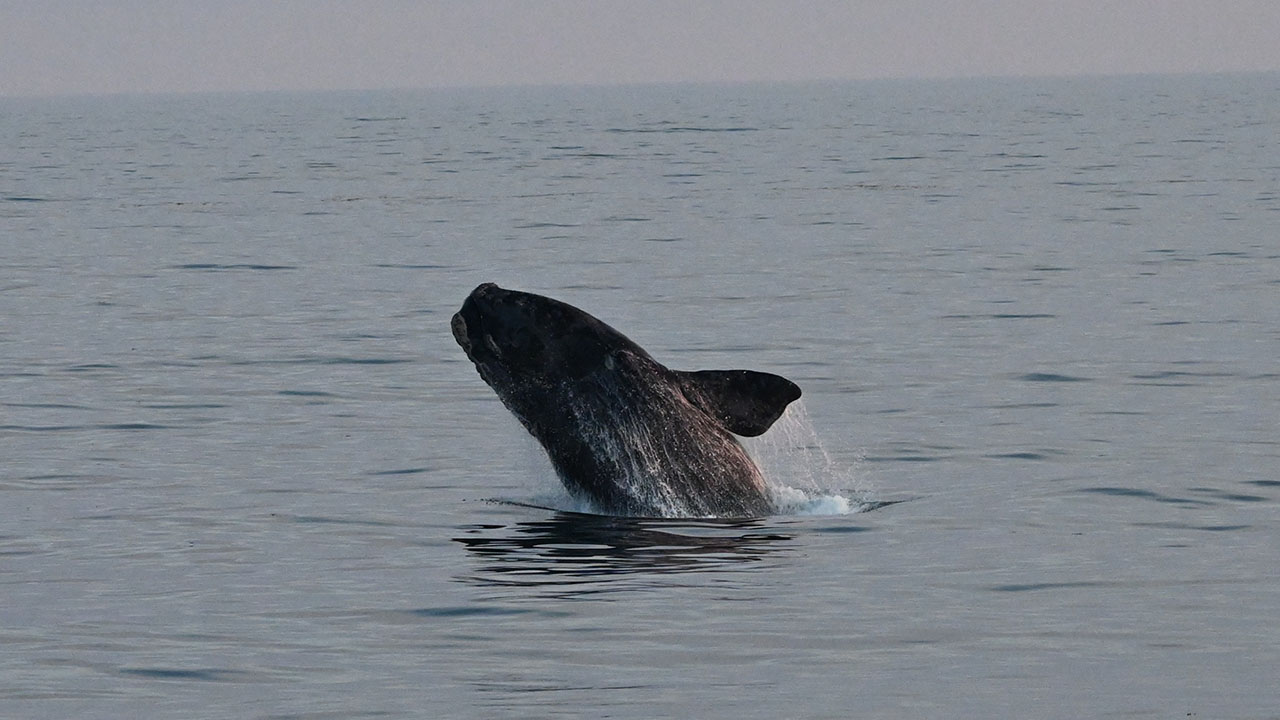
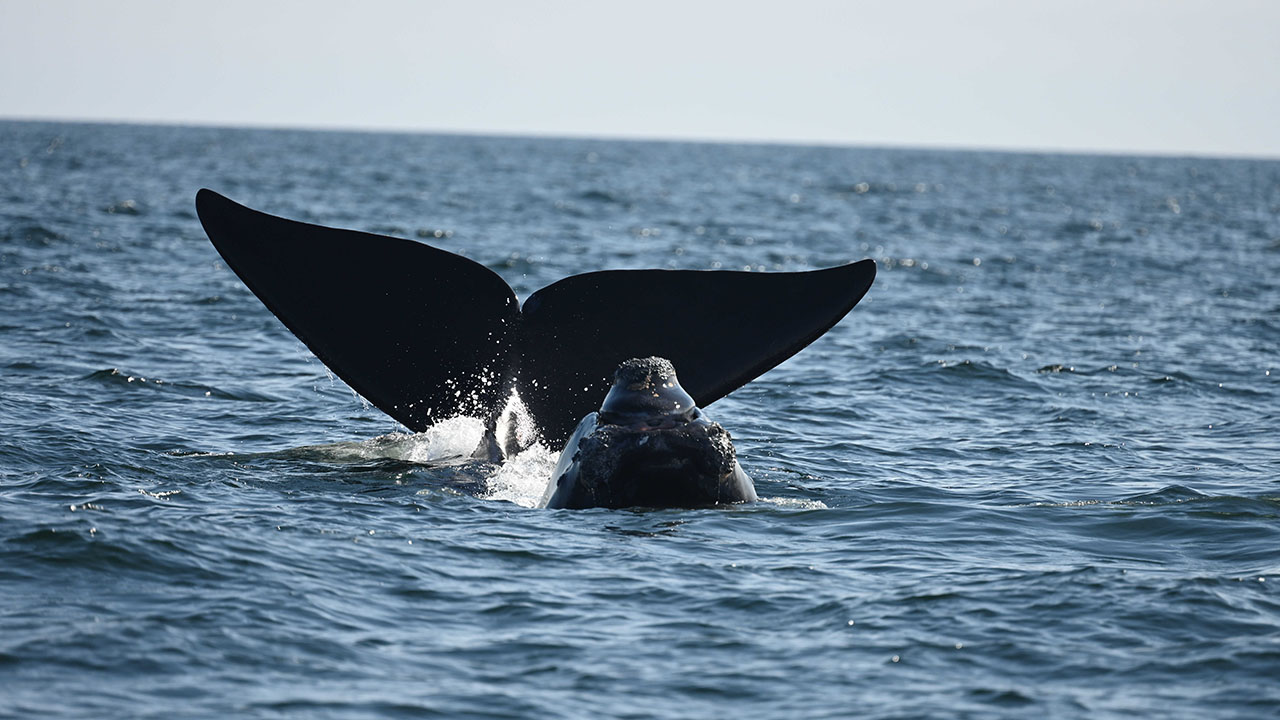
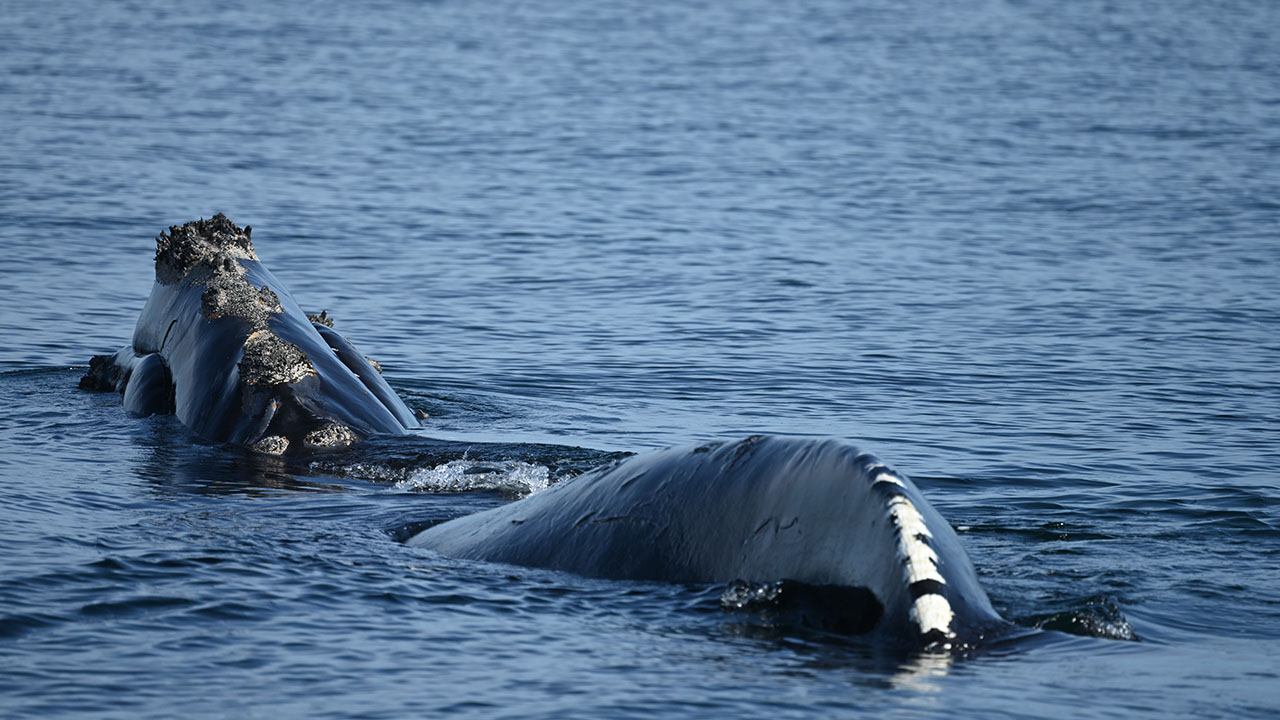
More broadly, understanding how right whales respond to approaching vessels of all kinds may also help identify new, more effective ways to reduce the risk of vessel strikes, one of the leading causes of injury and death for right whales. Of the 70 documented mortalities since 2000 with a determined cause, 30 were caused by vessel strike. This problem is not specific to right whales—many marine species are heavily impacted by vessel strike—but right whales appear to be struck at higher rates than other large whales, and with only about 380 whales estimated in the population, the health and survival of each individual is essential.
Measuring how whales respond to approaching vessels is challenging. Many variables such as vessel speed, size, propulsion type, and whale behavioral state can influence if or how a whale reacts. So during fieldwork in Cape Cod Bay this April, the Anderson Cabot Center team started with a more foundational question.
“What our research this spring focused on was assessing whether or not we can actually measure right whale response to vessel approaches in a reliable and objective way,” said Hansen Johnson, PhD, a research scientist in the Kraus Marine Mammal Conservation Program (KMMCP) at the Anderson Cabot Center, who leads KMMCP’s longstanding right whale fieldwork program. “The focus is on establishing that first, and then once we’re confident in this methodological approach we can start adding other variables like engine speed or vessel type.”
Designing the study
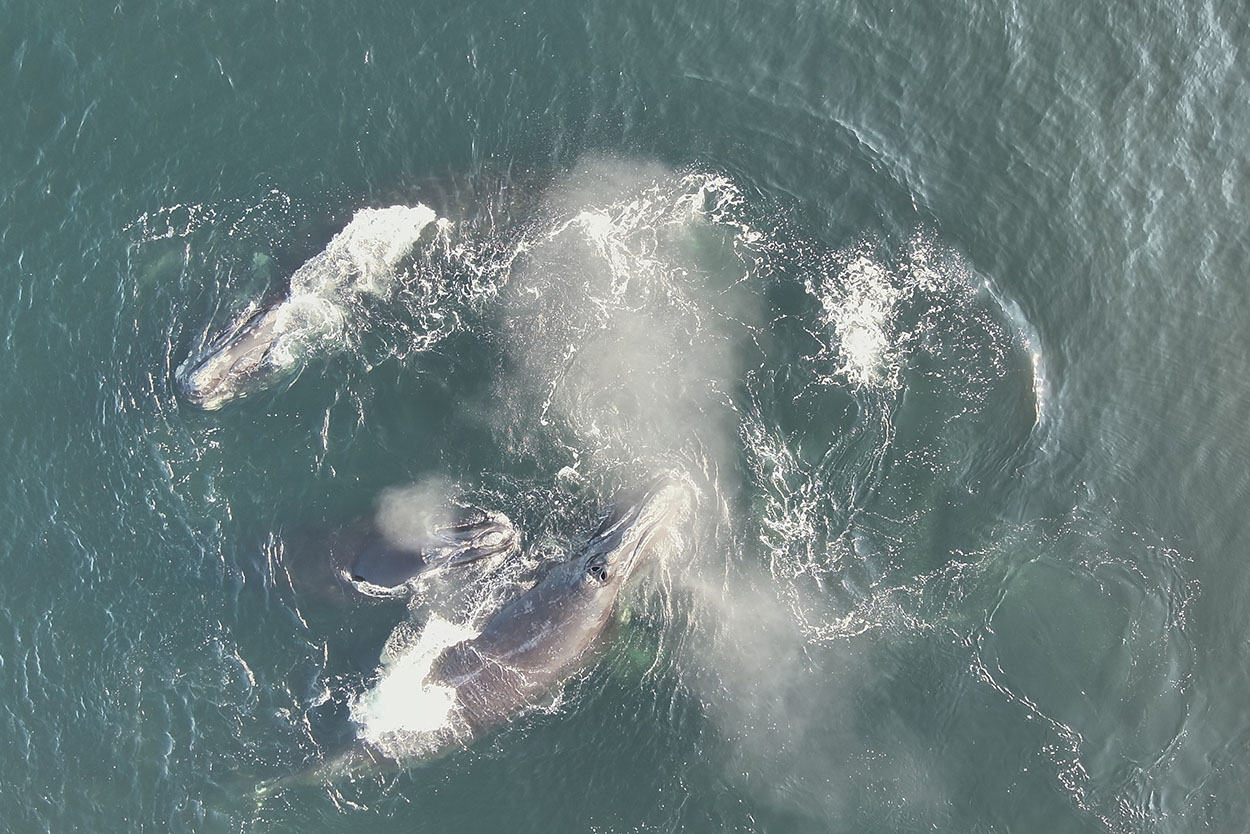
To build the method, the KMMCP researchers collaborated with the Anderson Cabot Center’s Ecology, Mapping, and Assessment of Marine Populations (EcoMAP) team, including senior scientist and department chair John Durban, PhD, who has spent decades developing drone-based photogrammetry for whales and dolphins. Photogrammetry uses calibrated aerial images to measure an animal’s length and width, which researchers translate into estimates of body condition and health that can be tracked across years. John has also pioneered a technique called spatially explicit photogrammetry, pairing each image with high-precision altitude and geographic location measurements so that a sequence of photos can be stitched together to objectively characterize where the whale went, how fast it swam, how sharply it turned, how often it surfaced to breathe, and more.
The team designed a study that combined several of their permitted research activities, including drone-based photogrammetry, vessel-based photo-identification (photo-ID), and passive acoustic monitoring, to measure right whale responses to a slowly approaching vessel. All of the team’s work with right whales is conducted under a federal research permit with strict approach and reporting requirements. Without a permit, it’s illegal to come within 500 yards of a right whale in U.S. waters, by boat or by drone.
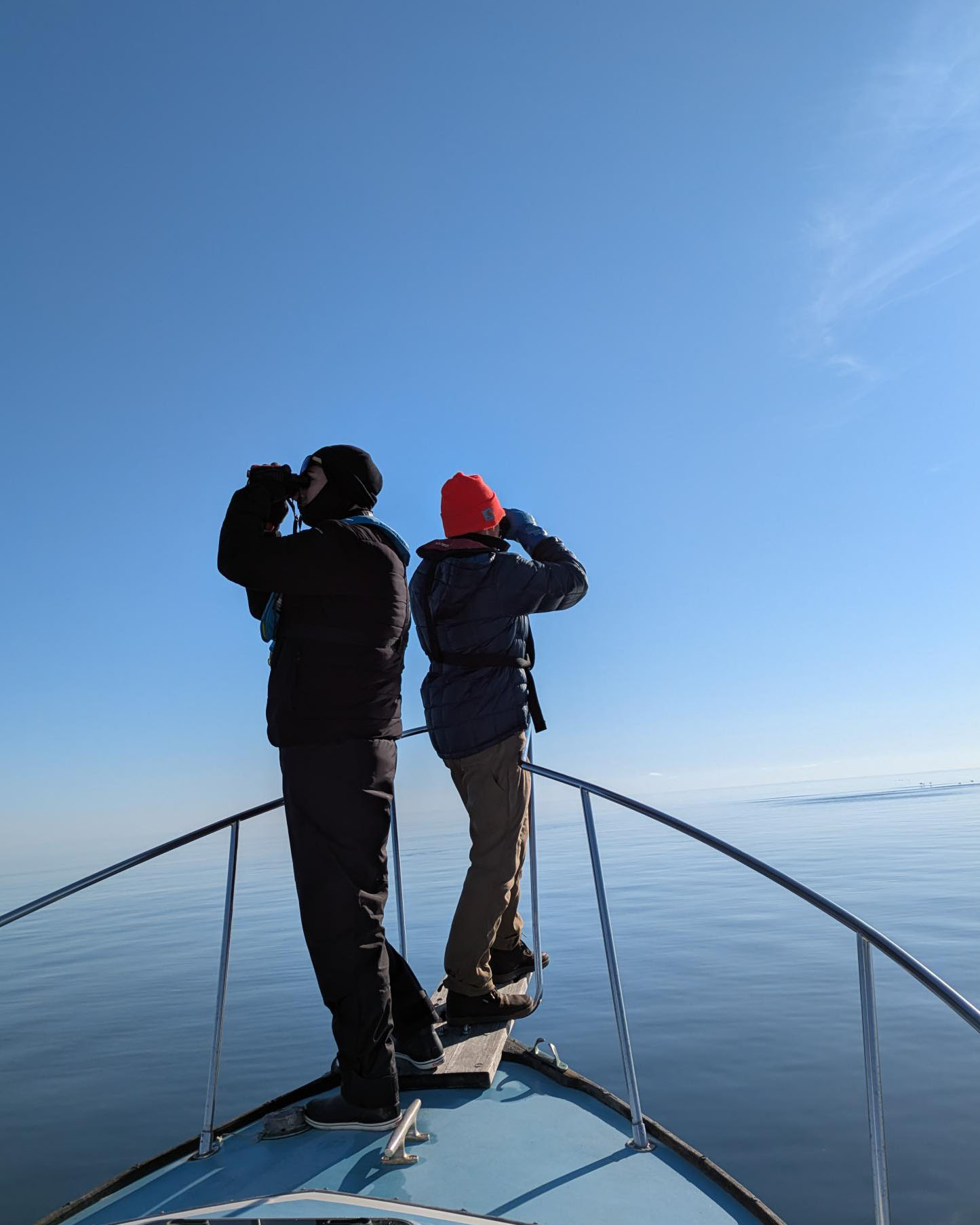
Their study design involved spotting a right whale at a distance, launching a drone more than 150 feet up, high enough that the whale was unaware of its presence, and tracking the whale’s movements with drone photogrammetry for eight to 10 minutes. Only then did the vessel start a typical photo-ID approach, moving slowly alongside the whale to get close enough to photograph its identifying markings without disturbing it. The drone would stay overhead during the approach, which typically lasted two to five minutes, and then continue to follow the whale for about 10 more minutes after the approach ended. “The idea is that we would compare the before, during, and after approach phases of this trial to see if there’s a quantifiable difference in how the whale is moving, or breathing, or turning, or swimming that’s in response to the boat,” Hansen explained.
Beneath the surface, a second data stream was running. The team deployed custom drifting acoustic recorders that Hansen designed and built in-house, and has been using since 2025. Dropped over the side of the boat, they record underwater sound levels along with their own positions as they drift.
The acoustics may turn out to be an important measure of whales’ calling behavior, whether they’re producing specific calls or calling at different rates during each phase of the trial. The recorders also capture the vessel noise the whales are exposed to before, during, and after the approach. “That’s most likely what they’re responding to with respect to the boat,” Hansen noted. “They’re more likely responding to the boat’s noise, rather than being able to see it.”
Conducting the study—despite challenges
Cape Cod Bay in spring typically offers the best chance anywhere on the East Coast of finding large numbers of right whales relatively close to shore in workable weather. But nature is unpredictable.
“There were fewer whales than usual, and the weather was tough,” Hansen said. Still, the team got out in the field on six days and completed 12 behavioral response trials, which they consider a good result given the circumstances.
What the whales were doing was unusual too. The team saw a higher proportion of mothers with calves than in past years, and almost no sign of the surface skim feeding that’s typical in the bay in spring. Whether this is the start of a trend is a question that the team will have to wait until next season to answer.
Twelve trials will likely be enough for the team to tell if this method can be used for measuring whale responses to approaching vessels. The harder question is how much natural variability the data may reveal. If a typical response to a vessel ranges from nothing at all to an immediate dive out of sight, subtler effects like the influence of engine RPM changes may require a large sample size or new study design to detect. Either way, “[this work] will definitely be helpful for informing next steps,” Hansen said.
The aerial imagery also complements John and the EcoMAP team’s long-term photogrammetry work, which can be used to track individual right whales’ body condition and pregnancies. The boat-based photographs go into the North Atlantic Right Whale Catalog, which is managed by KMMCP, contributing to population estimates and the tracking of human-caused scarring.
“That was another part of our motivation for this study design,” Hansen said, “to be able to collect new data on this fine scale behavior, but also still be getting a lot of the essential data streams that contribute to monitoring the health of the species in general.”
Partnering to protect right whales
The first project in the partnership between Irving Oil and the New England Aquarium set the tone for what followed. In 1999, Irving Oil funded a vessel strike working group, which petitioned to move Bay of Fundy shipping lanes around the right whale habitat there. The International Maritime Organization approved the change in 2002, and the lanes shifted in 2003. This set a precedent for later conservation-driven changes to vessel traffic, including a shift in the Boston shipping lanes in 2007 and the designation of an Area to Be Avoided in Roseway Basin off Nova Scotia in 2008. The partnership has extended beyond the field, too. Irving Oil employees and Aquarium and Anderson Cabot Center staff have visited schools across the US and Canada with an inflatable right whale to teach students about the species.
This year’s study, and much of the Anderson Cabot Center’s fieldwork and associated analyses over the last several decades, would not have been possible without Irving Oil’s continued support. “We’re grateful for Irving Oil’s commitment to advancing right whale conservation, and look forward to continuing to work together for years to come,” Hansen said.
Learn more about the Aquarium’s right whale research and our partnership with Irving Oil.

Related Stories

Take Action for the Ocean
Learn more about the New England Aquarium's work to protect the blue planet and how you can get involved with us.