On Wednesday, March 25, The Trust Family Foundation Shark and Ray Touch Tank will open to the public at 10:00 a.m.
What it’s Like Working at the Aquarium’s Sea Turtle Hospital
From cold-stunning season to long-term rehabilitation, a senior biologist shares what it takes to rehabilitate injured sea turtles.
By New England Aquarium on Tuesday, March 24, 2026

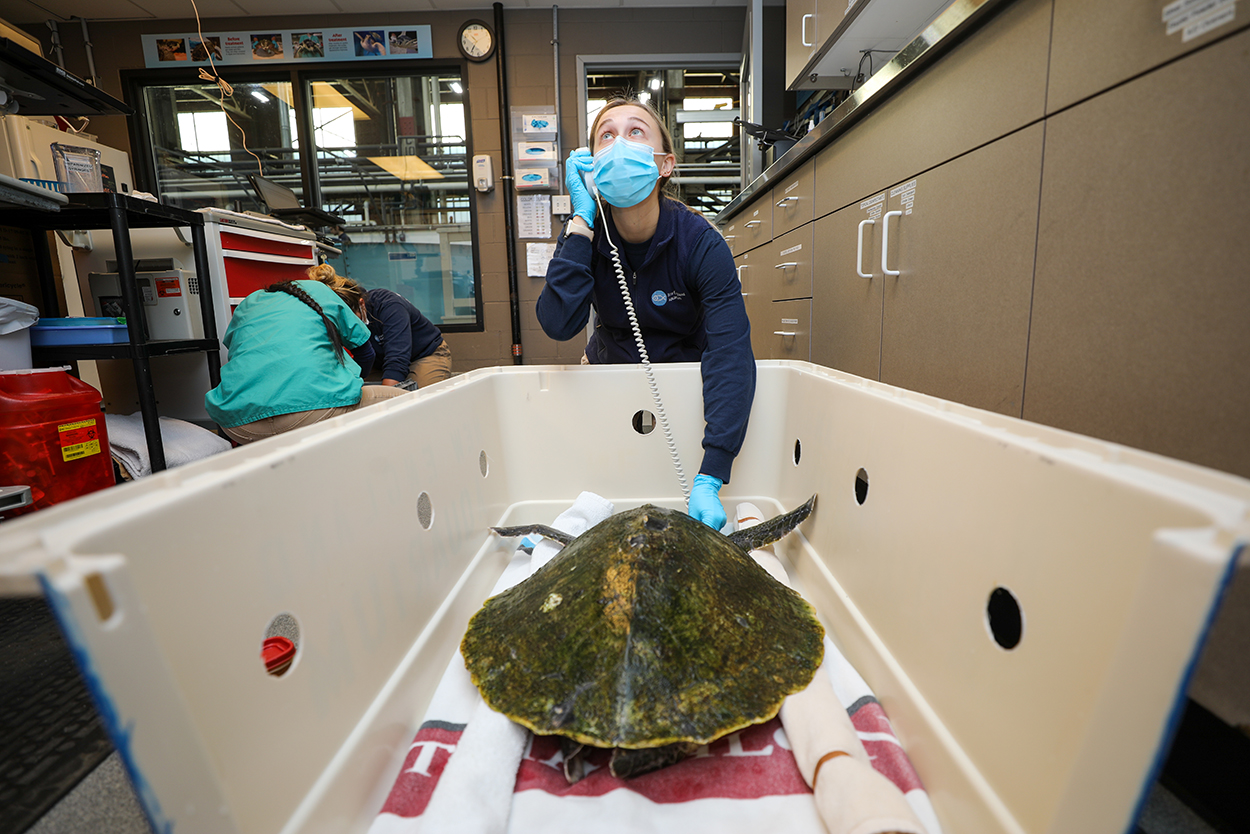
At the New England Aquarium’s Sea Turtle Hospital at our Animal Care Center in Quincy, no two days are the same.
The hospital is staffed by a team of nine, supported by seasonal employees, interns, and volunteers who all play a crucial role in caring for hundreds of recovering sea turtles each year.
From season to season, the pace and priorities at the Sea Turtle Hospital shift—from urgent rescues in late fall to the steady, detail-oriented work of rehabilitation through winter and spring, and, finally, release season in the summer.
Kristen Luise, senior biologist at the Aquarium, has experienced every part of that cycle over her five years at the Sea Turtle Hospital. Here’s what it’s like to be part of the team working with these unique patients.
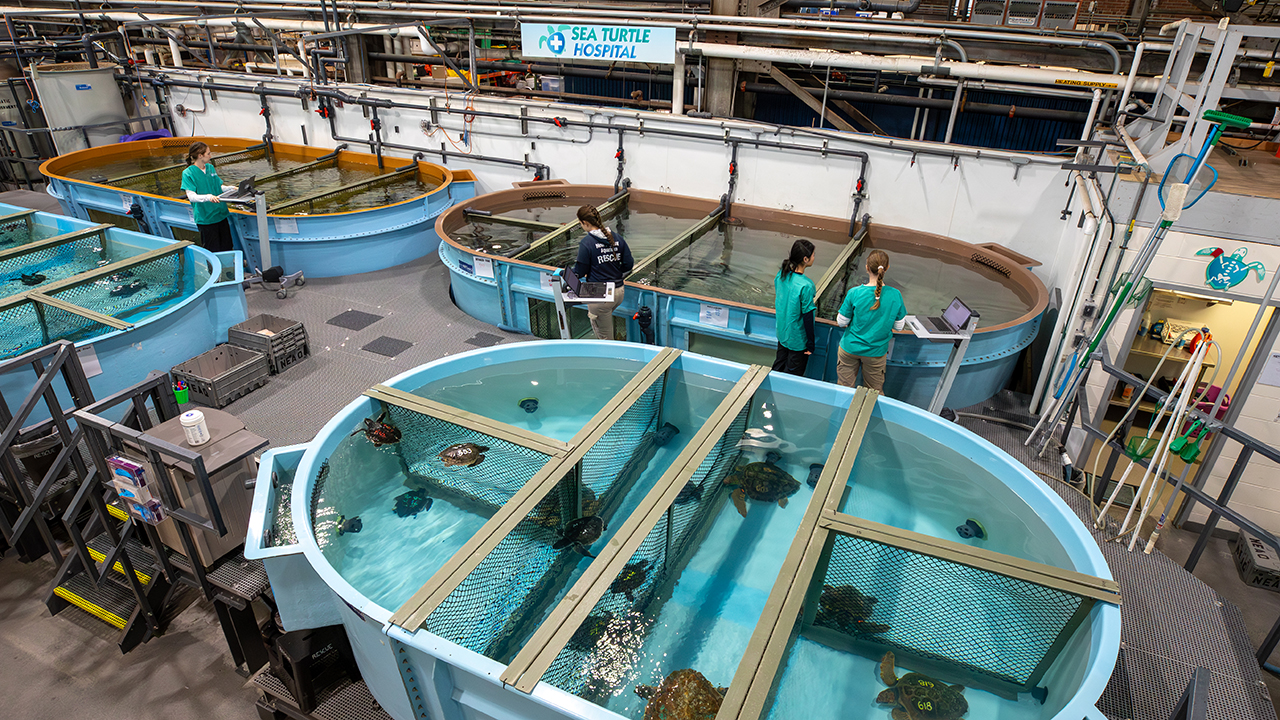
Cold-stunning season: “Organized chaos”
Usually in late October, when water temperatures in Cape Cod Bay begin to drop to about 55˚ F, the hospital enters its busiest and most hectic time: cold-stunning season.
Cold-stunning occurs when sea turtles are exposed to rapidly dropping water temperatures, leaving them lethargic, unable to swim, and frequently stranded along Cape Cod beaches. The turtles are rescued by volunteers from Mass Audubon Wellfleet Bay Wildlife Sanctuary, and brought to the Aquarium for treatment. By the time they arrive at the Sea Turtle Hospital, many are fighting for survival—suffering from pneumonia, dehydration, injuries, and frostbite.
On any given day, the Sea Turtle Hospital might admit five turtles or more than 80.
“The best way to describe it is organized chaos,” Kristen said. “It’s a lot of time and delegation and working as a team and being really organized.”
The intake process is a fast but thorough assessment of each patient. The team photographs every turtle, records their weight, checks for injuries, and runs swim and diagnostics tests, including blood work and radiographs. They then begin slowly warming the turtle to their normal body temperature of about 75°F.
Based on test results, the team develops individualized treatment plans, often including fluid therapy and antibiotics. Some turtles require more advanced diagnostics or treatment.
“We work closely with our Animal Health Department performing procedures such as bronchoscopies and tracheal washes, as well as taking turtles off-site for CT scans,” Kristen said. “There really is a lot that we can do to learn about these turtles and help treat them. Things that humans get, the turtles can get.”
Each turtle is given a name based on a new theme each year. Last year, the theme was Greek mythology. This year, the theme is fonts, with turtles at the facility including Papyrus, Wingdings, and Meep.
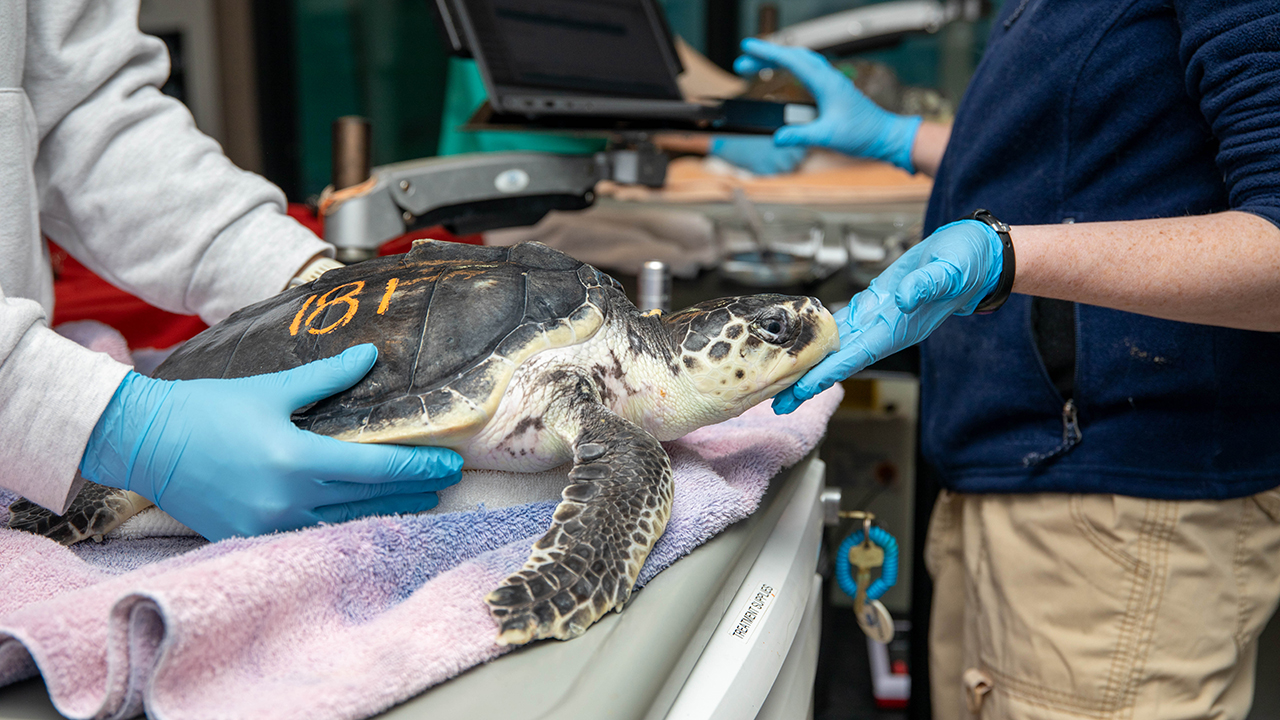
Long-term care: The slow work of recovery
Once the rush of the cold-stunning season subsides, the team’s work takes on a new rhythm. “Even though technically the busy season is over, a lot of times, they’re still not out of the woods,” Kristen said. “We still have some pretty sick turtles.”
The hospital usually houses between 50 to 70 long-term patients. At the time of writing, 58 turtles are undergoing extended rehabilitation, and the majority are Kemp’s ridley turtles, a critically endangered species.
The goal is to eventually ensure they are all able to swim and forage on their own, behaviors they’ll need to survive in the ocean. Most long-term patients stay for three to six months before they are ready to return to the Atlantic.
During the rehabilitation process, feeding takes up much of the team’s day. Some turtles eat on their own, while others require more hands-on care. For those turtles, staff use tongs to feed them directly, ensuring they’re getting the nutrition and any medication they need to heal and rebuild their strength.
Staff and volunteers also closely monitor each turtle’s behavior in the recovery pools—watching how they swim, dive, breathe, and use their flippers—and document that progress through daily notes.
“Each year, it never fails to amaze me how resilient these turtles are,” Kristen said. “[They] can come back from having heart rates that are undetectable, but then the next day, they’re swimming around in the tank, and then they’re eating on their own.”
She recalled a recent patient, whose font-themed name is “Young Frankenstein,” who arrived severely underweight and required tube feeding for weeks but has since begun eating independently.
“It’s really amazing to see and know that the work that you’re doing is helping to make that difference,” she said.
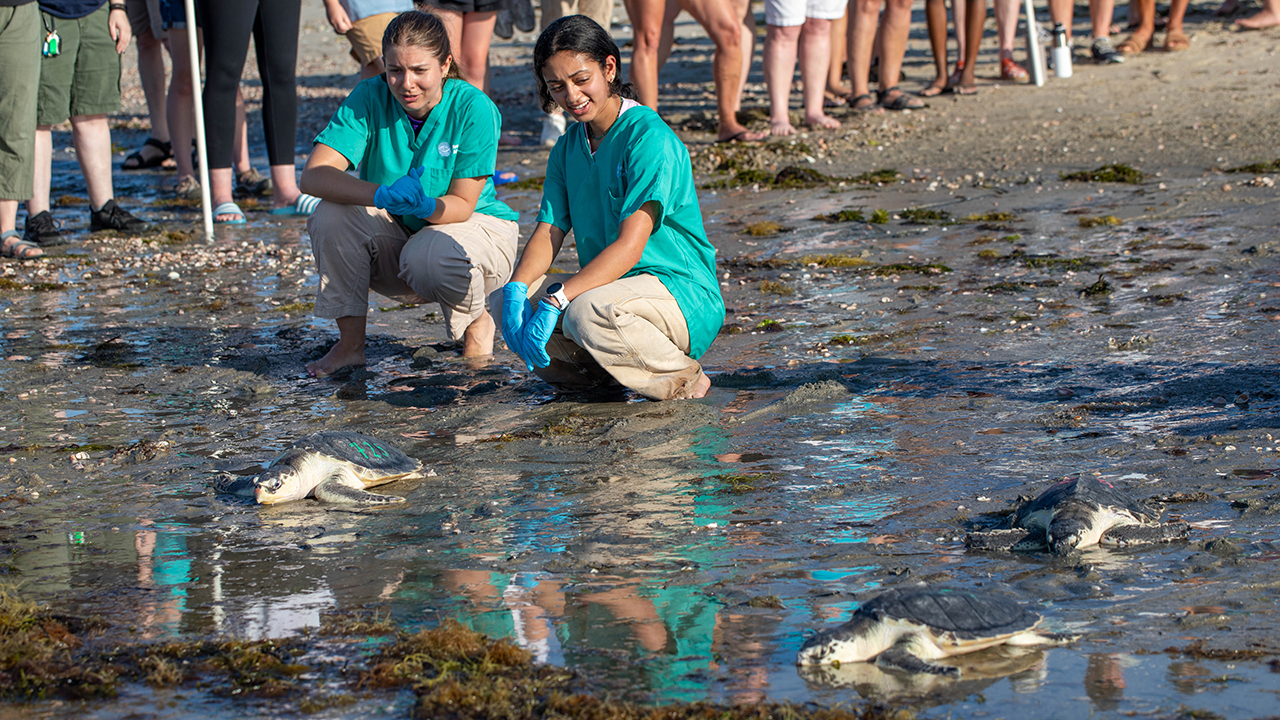
Release season: Return to the ocean
By summer, the focus shifts once more, from recovery to release.
Turtles who require more time to heal are transferred to partner rehabilitation facilities to continue their progress. Those who have demonstrated their ability to swim and eat independently are transported back to Cape Cod beaches, where they’re released and make their way back to the ocean.
“No matter how many releases I go on, it is still such a special feeling,” Kristen said.
Soon after, preparation for the next cold-stunning season begins.
The team trains new volunteers and interns, reviews the previous season to plan improvements, and prepares the facility—draining and cleaning tanks, maintaining life support systems, and restocking supplies.
There’s also time for research, with staff pursuing individual projects that advance understanding of sea turtle health and care, from using satellite telemetry data to study post-release surfacing behaviors to investigating the average heart rate of recovering turtles.
A growing challenge—and a constant source of hope
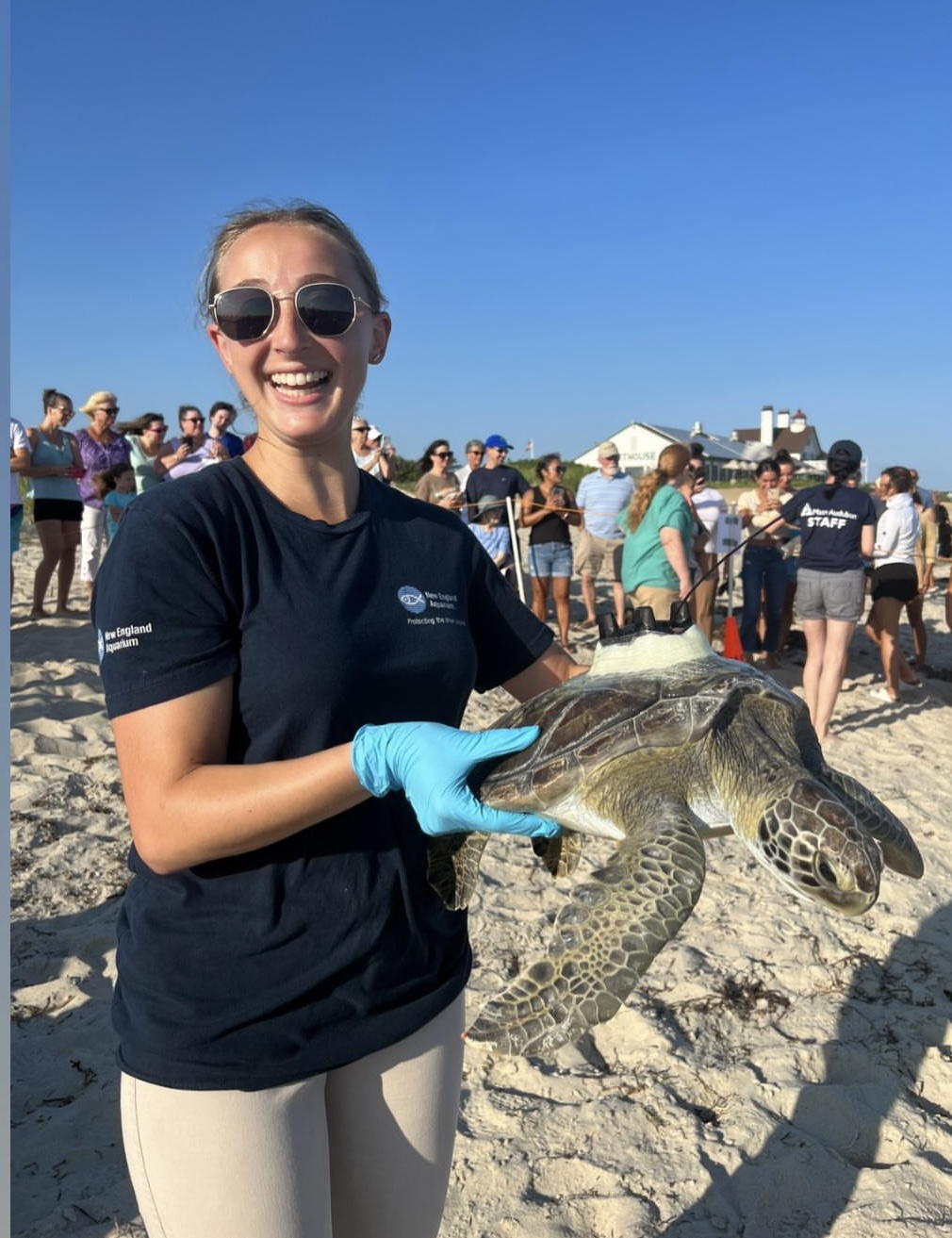
Five out of the seven species of sea turtle are currently listed as “critically endangered” or “vulnerable” by the International Union for Conservation of Nature (IUCN), making every rescue part of a larger global effort. Each turtle that is rescued and released has the potential to reproduce and make a positive impact on its population.
As ocean conditions continue to change, cold-stunning events are expected to increase.
“This is happening, and it’s not stopping,” Kristen said. “If anything, we are expected to get more turtles each year.”
If there’s one thing that is consistent at the Sea Turtle Hospital, though, it is the strength of both its team and patients.
“Each turtle is never alike, but they’re all resilient,” Kristen said.
You can support the Sea Turtle Hospital’s lifesaving work by visiting the New England Aquarium, where every visit helps make sea turtle rescue and rehabilitation possible.

Related Stories

Make a Difference for Sea Turtles
Your support makes a difference for threatened and endangered marine life everywhere by helping provide the Aquarium with the resources to conduct research, advocate, and rehabilitate.