Relationships of corticosterone and thyroxine with mortality, mass gain, feeding and activity in Kemp’s ridley sea turtles (Lepidochelys kempii) recovering from cold-stunning
By Kathleen E. Hunt, Elizabeth A. Burgess, Constance Merigo, Adam E. Kennedy, Danielle Dillon, C. Loren Buck, Jodie Treloar, Katherine Graham, Simran Chambers, Teagan Tinuviel, Rosalind M. Rolland, Charles Innis
Originally published in PLOS ONE in June 2025

Abstract
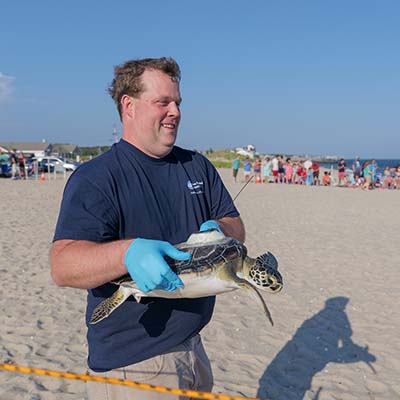
Mass strandings of juvenile Kemp’s ridley sea turtles (Lepidochelys kempii) occur annually on the shores of Cape Cod, Massachusetts, USA, during the months of Oct-Dec. Strandings have increased from dozens to hundreds per year in the past two decades, challenging recovery and management of this critically endangered species. Most stranded turtles are suffering from “cold-stunning”, a life-threatening hypothermia-like condition, and are brought to nearby marine animal veterinary clinics for treatment and rehabilitation. Though most individuals survive, some mortality does occur, and even among surviving turtles there can be prolonged deficits in health and behavior. Previous studies have indicated that upon admission, the adrenal stress hormone corticosterone is elevated approximately an order of magnitude above presumed baseline, while plasma thyroxine is often undetectable, suggesting that these two hormones show promise as markers of recovery from cold-stunning. In this prospective study, 106 cold-stunned Kemp’s ridleys were monitored during rehabilitation, with serial blood sampling at 0, 3, 7, 18, 30, 60 and 80 days post-admission to compare plasma concentrations of corticosterone and thyroxine to mortality, mass gain, feeding and activity. Corticosterone and thyroxine normalized in 88% of turtles by approximately day 18, but 12% showed persistent elevations of corticosterone (typically 2-3x above baseline), and persistently low thyroxine. Elevated corticosterone at day 18 was found to be predictive of mortality after day 18. The endocrine profile of high corticosterone and low thyroxine is also associated with lower rates of gain in body mass over time and reduced feeding. As prolonged deficits in growth affect body size at release, low mass gain may affect the predation risk on these juvenile turtles subsequent to release. These results suggest that endocrine biomarkers are useful for monitoring recovery of turtles in rehabilitation, and that growth rates and mass gains during rehabilitation may warrant further investigation.
Full Text
- Read at PLOS ONE
Affiliated Authors



Related Stories

Research That Drives Action
Through pioneering conservation research and strategic partnerships, our team of 40 scientists at the Anderson Cabot Center for Ocean Life works to combat the unprecedented impacts on the ocean from climate change and other human activities.
